Integrating human intuition, AI, and robotics to build an autonomous science powerhouse
What is ORNL’s Autonomous Chemistry Laboratory?
ORNL’s Autonomous Chemistry Lab (ACL) is one of the most flexible and powerful tools for autonomous experimentation in chemistry throughout the world.

The 1,200-square-foot facility was designed from the ground up to pursue autonomous experimentation in both solid and liquid chemistry, a novel and powerful approach to accelerate discovery. The ability to pursue solid-state chemistry and straddle the interface between liquid and solid chemistry opens new areas of inquiry in characterization, synthesis, and testing for ORNL’s researchers.
The lab was designed to address challenges that are strategically important to the U.S. Department of Energy and ORNL, including energy storage, liquid-liquid separations for critical materials, catalysis for energy production, and polymer synthesis for structural materials.
How the Autonomous Chemistry Lab Works
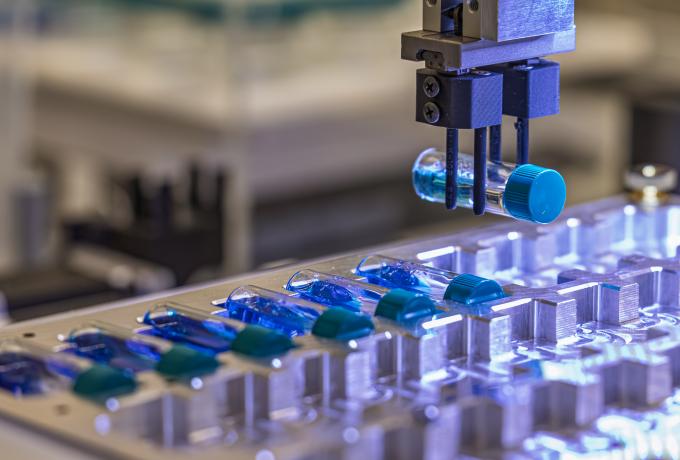
The lab features a mixture of ultraprecise robotics for synthesis, cutting-edge characterization tools, and bespoke equipment built in-house, much of it machined or 3D printed to exact specifications driven by the science mission. The lab’s half dozen robots handle tasks ranging from movement of samples between stations to coordinating the mixing and reaction of chemicals using customized grippers designed to manipulate a wide variety of tools.

Advanced AI workflows allow round-the-clock operations, reducing time-to-discovery and freeing up researcher time to pursue new concepts. Autonomous experimentation allows new ideas to be tested in the lab and quickly modified, expanded, or discarded, all with minimal human oversight.
The ACL’s design leverages the strength of AI to analyze large data sets to detect new correlations while guiding hypothesis refinement and conducting tasks with extreme precision. A forthcoming study demonstrated that the precision of robotic synthesis combined with AI-driven sample selection resulted in scientific conclusions in a third the time that a human researcher would require in a traditional lab. Strong emphasis is placed on reproducibility and data retention, ensuring AI tasks are carried out accurately and can be leveraged to further train AI agents to advance experimentation.
How the Autonomous Chemistry Lab Advances AI-Driven Scientific Discovery
The hardware innovations are backed up by ORNL’s singular capabilities in AI and high-performance computing. The ACL is fully integrated into ORNL’s INTERSECT ecosystem, which allows it to run AI-driven workflows and connect and collaborate with other laboratories across the campus. The ACL will also play a key role in ORNL’s forthcoming Labs of the Future initiative.
Contact Information
Craig A Bridges
R&D Staff – Physical Chemist
865.574.6511
[email protected]