
Decades of quantum innovation
1944 – 1951: Ernest Wollan’s and Clifford Shull’s contributions to early quantum research
Working at ORNL’s Graphite Reactor, Ernest Wollan and Clifford Shull made foundational contributions to early quantum research at Oak Ridge National Laboratory by developing neutron diffraction, a technique that uses the wave-like properties of neutrons to probe the atomic and magnetic structures of matter. Their work provided some of the first direct experimental confirmations of quantum mechanical predictions regarding material structures.

Ernest Wollan (seated) and Clifford Shull (standing) conducted some of the world’s first neutron scattering experiments.
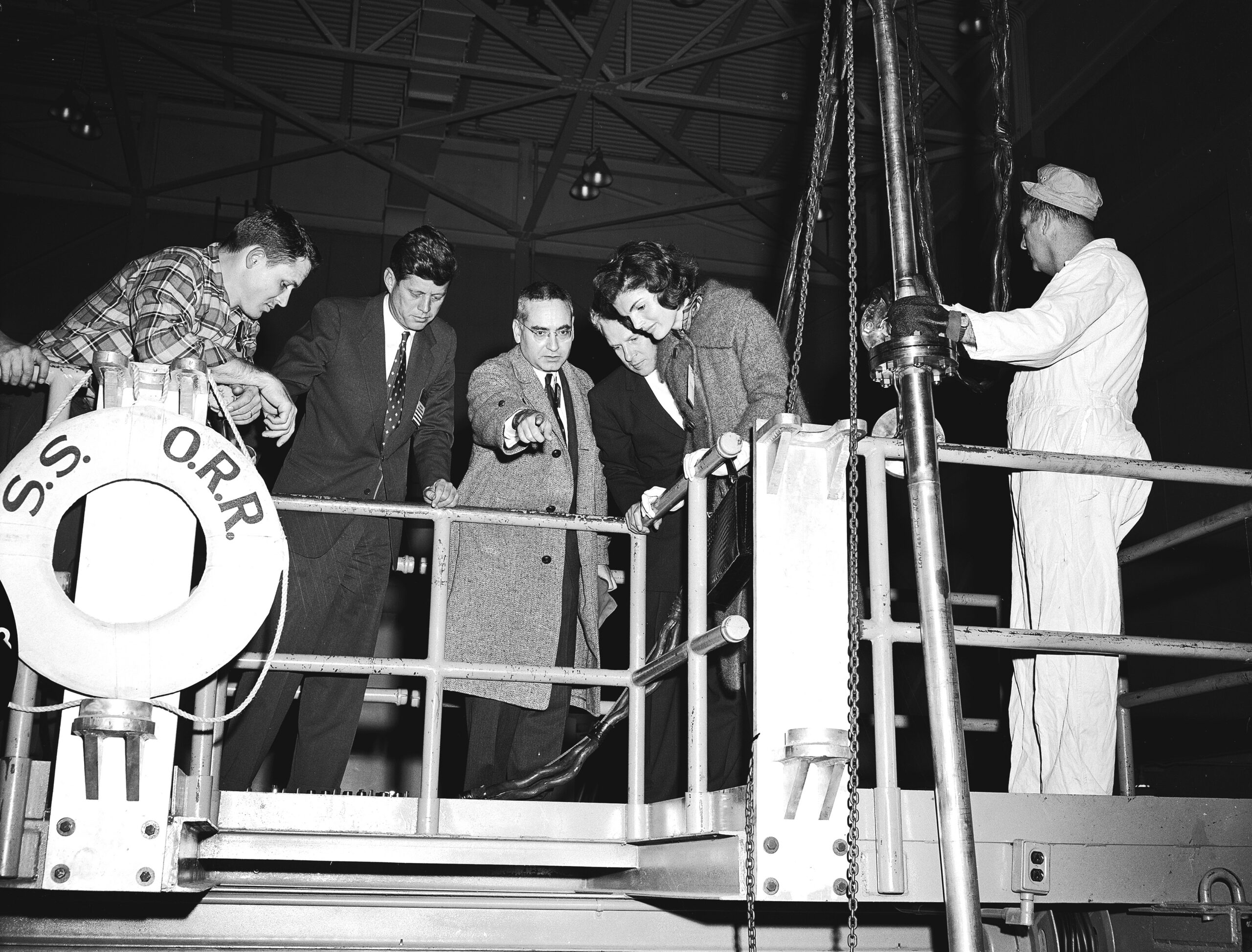
Alvin Weinberg with Massachusetts Senator John Kennedy and Jacqueline Kennedy at the Oak Ridge Research Reactor (ORR).
1957 – 1986: Oak Ridge Research Reactor
The Oak Ridge Research Reactor served as a vital bridge for quantum physics by transforming neutron scattering from a pioneering experiment into a high-precision diagnostic tool for quantized excitations. With a neutron flux 300 times greater than the original Graphite Reactor, the ORR allowed scientists to move beyond simply locating atoms to measuring the energy of phonons (quantum units of vibration) and magnons (quantum units of magnetic spin). By observing these discrete energy transfers, the ORR provided essential experimental validation of the quantum mechanical prediction that heat and magnetism in solids are not continuous, but travel in distinct, “quantized” packets.
1965 – Present: High Flux Isotope Reactor
The High Flux Isotope Reactor (HFIR) elevated quantum research to the level of collective electronic phenomena, becoming a premier site for studying quantum materials and entanglement. Its most profound “quantum connection” lies in the development of neutron polarization analysis in 1969, which allowed researchers to isolate the quantum spin of the neutron to probe complex magnetic symmetries. This capability was instrumental in proving the existence of the Bose-Einstein Condensate fraction in liquid helium and identifying the magnetic “glue” responsible for high-temperature superconductivity. Today, HFIR remains at the forefront of the field, probing “topological” quantum states and quantum spin liquids, where electron spins remain in a fluid-like state of entanglement even at absolute zero.
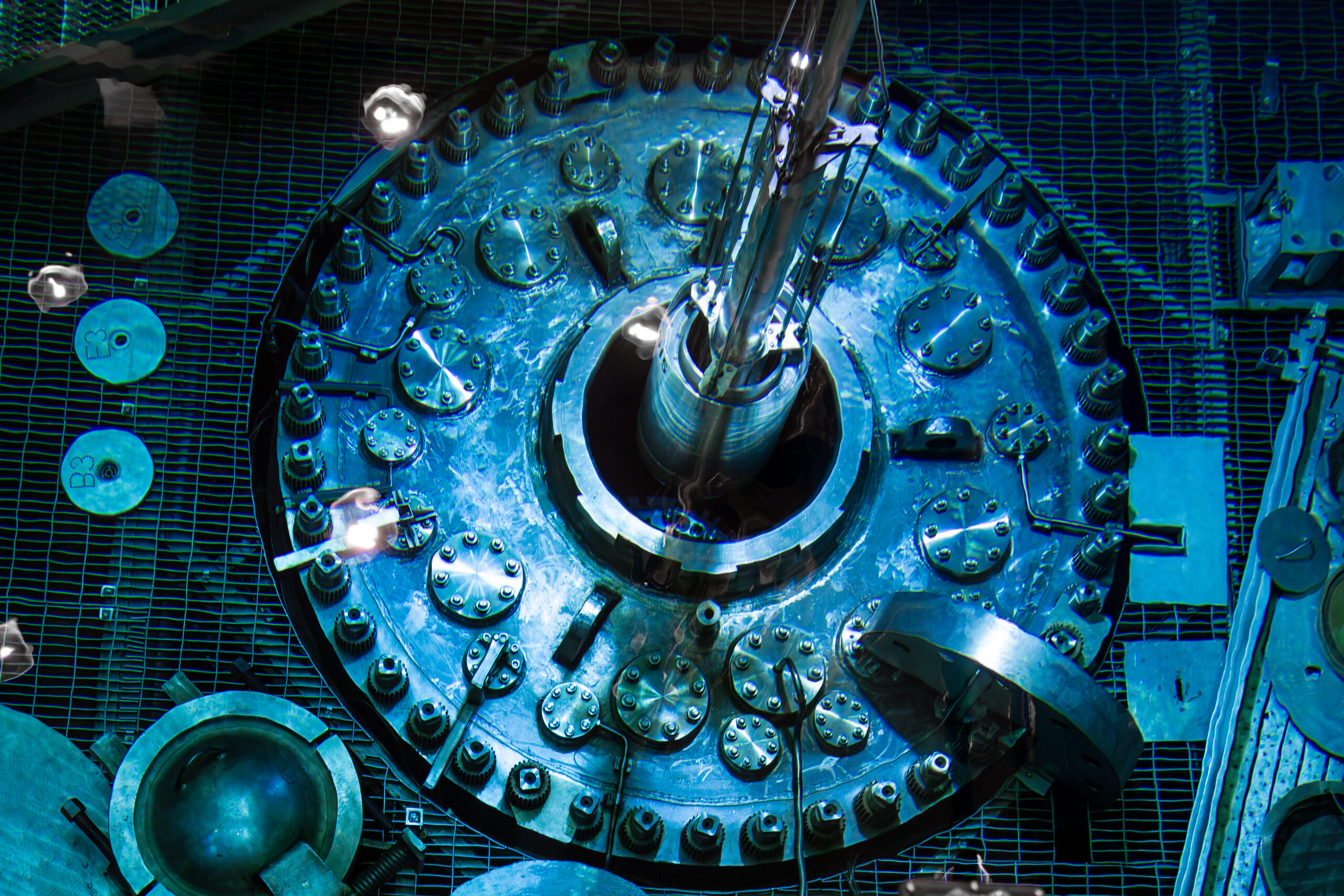
High Flux Isotope Reactor core

Oak Ridge Electron Linear Accelerator
2010: Physics – Surprising nucleon behavior
Data from ORNL on neutron interactions with isotopes of platinum contradict a basic assumption underpinning random matrix theory, nuclear physics models and quantum chaos. For more than a half century, scientists have assumed that highly excited states in intermediate- to heavy-mass nuclides are chaotic, and that data support this assumption. However, new data from the Oak Ridge Electron Linear Accelerator strongly disagree.
2012: Physics – Searching for ‘supersolidity’
Theoretical physicists have long predicted the existence of a quantum state of matter they call “supersolidity,” in which solid helium-4 loses its viscosity and flows like a liquid. Researchers are using the Spallation Neutron Source in a series of studies to pin down whether this paradoxical new state of matter can be demonstrated.

Spallation Neutron Source

The research links electron movement to structural elements such as single point defects or impurities that are intentionally grown in the nanowires.
2012: ORNL microscopy explores nanowires’ weakest link
Individual atoms can make or break electronic properties in one of the world’s smallest known conductors—quantum nanowires. Microscopic analysis at ORNL is delivering a rare glimpse into how the atomic structure of the conducting nanowires affects their electronic behavior.
2016: ORNL neutron ‘splashes’ reveal signature of exotic particles
Researchers at ORNL used neutrons to uncover novel behavior in materials that holds promise for quantum computing. The findings, published in Nature Materials, provide evidence for long-sought phenomena in a two-dimensional magnet.

This rendering illustrates the excitation of a spin liquid on a honeycomb lattice using neutrons.

Red arrows represent electron spin orientations in a portion of the YbMgGaO4 crystal structure.
2016: Neutrons identify key ingredients of the quantum spin liquid recipe
Individual atoms can make or break electronic properties in one of the world’s smallest known conductors—quantum nanowires. Microscopic analysis at ORNL is delivering a rare glimpse into how the atomic structure of the conducting nanowires affects their electronic behavior.
2017: New method to detect spin current in quantum materials unlocks potential for alternative electronics
A new method that precisely measures the mysterious behavior and magnetic properties of electrons flowing across the surface of quantum materials could open a path to next-generation electronics.
Found at the heart of electronic devices, silicon-based semiconductors rely on the controlled electrical current responsible for powering electronics. These semiconductors can only access the electrons’ charge for energy, but electrons do more than carry a charge. They also have intrinsic angular momentum known as spin, which is a feature of quantum materials that, while elusive, can be manipulated to enhance electronic devices.

A new microscopy method developed by an ORNL-led team is sensitive to the spin of moving electrons and produces high-resolution results.

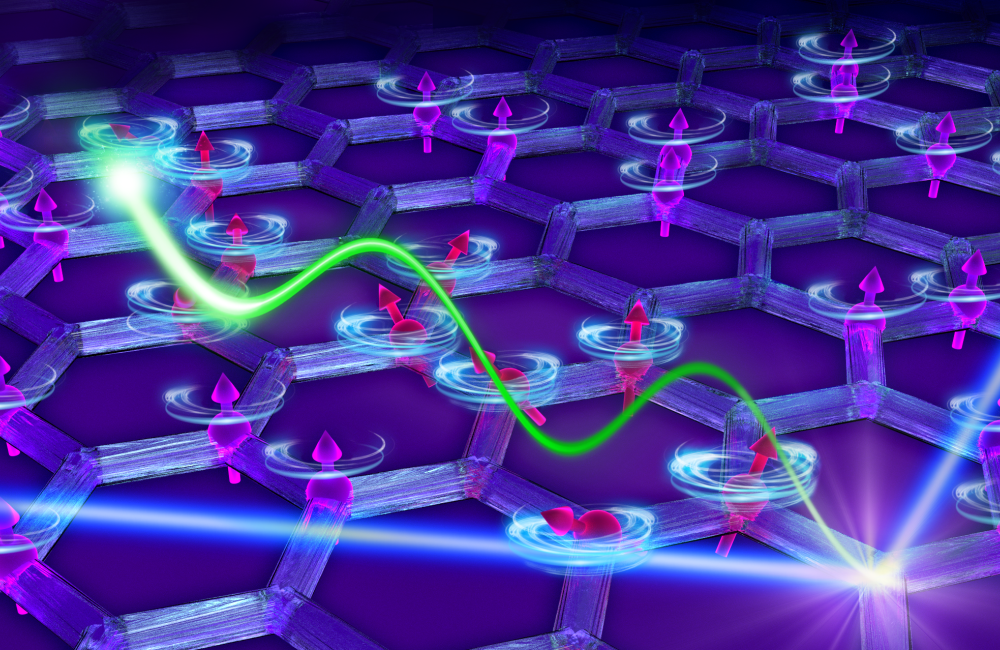
As neutrons (blue line) scatter off the graphene-like honeycomb material, they produce a magnetic Majorana fermion (green wave).
2017: Neutrons zero in on the elusive magnetic Majorana fermion
Neutron scattering has revealed in unprecedented detail new insights into the exotic magnetic behavior of a material that, with a fuller understanding, could pave the way for quantum calculations far beyond the limits of the ones and zeros of a computer’s binary code.
A research team led by ORNL has confirmed magnetic signatures likely related to Majorana fermions—elusive particles that could be the basis for a quantum bit, or qubit, in a two-dimensional graphene-like material, alpha-ruthenium trichloride.
2018: ORNL in the 21st century and beyond
ORNL was built on Big Science—a term coined in 1961 by Alvin Weinberg—and 75 years later the lab is still dedicated to that approach. By gathering thousands of talented scientists and engineers and giving them access to uniquely powerful research facilities, ORNL accelerates both our access to fundamental knowledge and our society’s ability to use that knowledge to provide clean, new technologies.

The klystron gallery supplies power to SNS’s linear accelerator by taking electricity from the main power lines and converting it to the levels needed.

ORNL researcher Sergei Kalinin with a helium ion microscope at the lab’s Center for Nanophase Materials Sciences. Image credit: Carlos Jones, ORNL
2018: Microscopy and computing for futuristic materials
Integrating electron microscopy and atomic imaging with big data technologies is a monumental task, but the end result is a deeper, more powerful understanding and control over materials functionality at the atomic level. That understanding is what attracted Sergei Kalinin, a researcher at the Center for Nanophase Materials Sciences.
2018: Neutrons and quantum materials
Neutron scattering scientist Clarina dela Cruz uses the powerful tools at SNS and HFIR to investigate quantum materials, whose exotic physical properties arise from the quantum mechanical properties of their electrons. Dela Cruz’s research lies at the nexus of topology, quantum field theory and quantum information science, with a healthy amount of materials and computer science. She uses neutron scattering techniques to study the structural, electronic and magnetic properties and correlations in novel quantum materials such as unconventional superconductors, quantum magnets and multiferroic systems with switchable electric and magnetic functionalities.

ORNL researcher Clarina dela Cruz at HFIR. Image credit: Genevieve Martin, ORNL
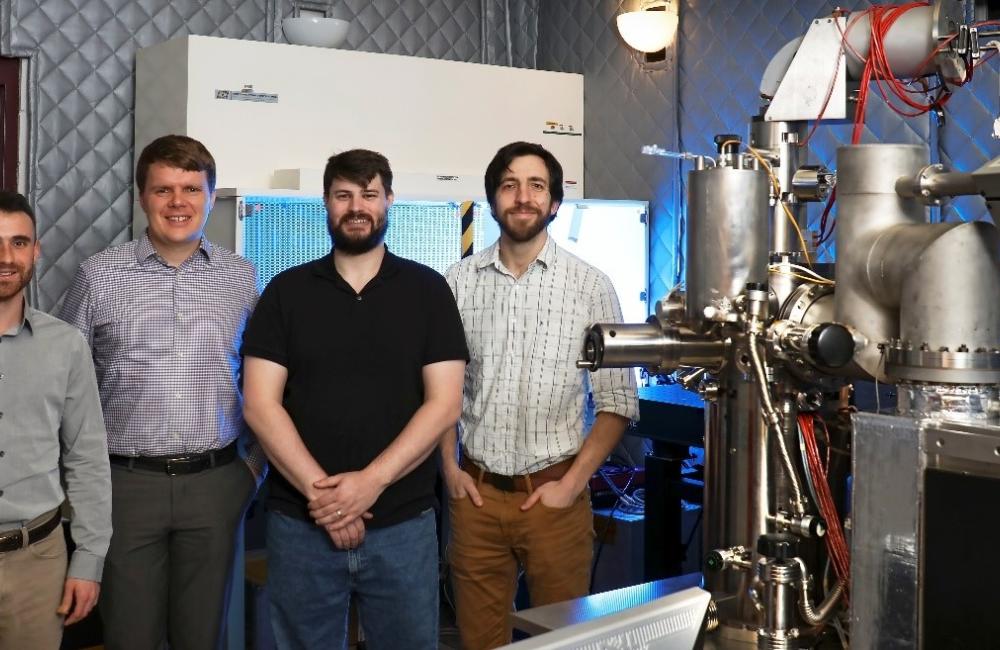
ORNL researchers have conducted investigations aimed at controlling the dissipative nature of quantum systems and materials.
2018: Putting quantum scientists in the driver’s seat
Scientists at ORNL are conducting fundamental physics research that will lead to more control over mercurial quantum systems and materials. Their studies will enable advancements in quantum computing, sensing, simulation, and materials development.
2018: Scientists forge ahead with electron microscopy to build quantum materials atom by atom
A novel technique that nudges single atoms to switch places within an atomically thin material could bring scientists another step closer to realizing theoretical physicist Richard Feynman’s vision of building tiny machines from the atom up.
A significant push to develop materials that harness the quantum nature of atoms is driving the need for methods to build atomically precise electronics and sensors. Fabricating nanoscale devices atom by atom requires delicacy and precision, which has been demonstrated by a microscopy team at ORNL.

Researchers used a scanning transmission electron microscope to introduce silicon atoms into a single-atom-thick sheet of graphene.
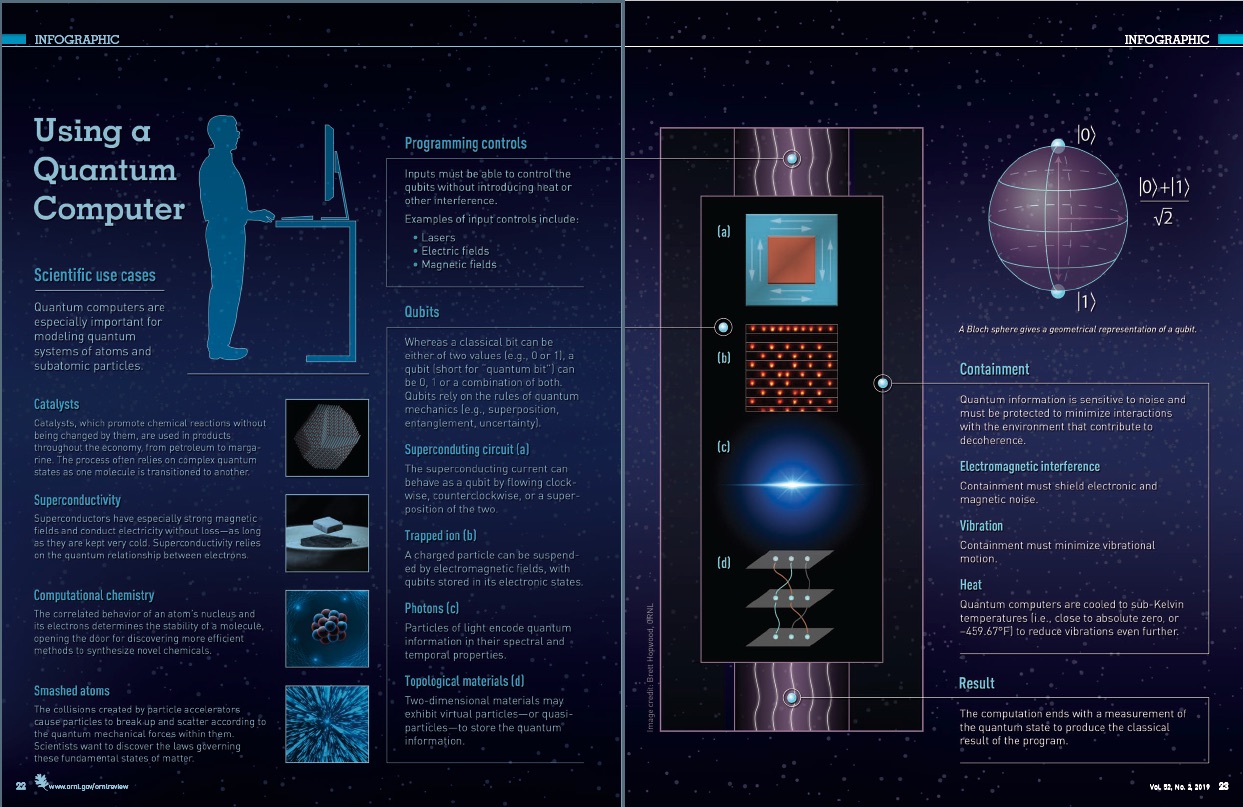
2018: Using a quantum computer (infographic)
Quantum computers are especially important for modeling quantum systems of atoms. and subatomic particles.
2019: Quantum Computing is ideal for quantum problems’
The promise of computers that exploit the strange behavior of subatomic particles has tempted scientists for decades. In time, quantum computers will likely tackle problems that are difficult or even impossible to solve on a traditional computer—from simulating the behavior of electrons and molecules to advancing artificial intelligence—but daunting challenges must be overcome first.
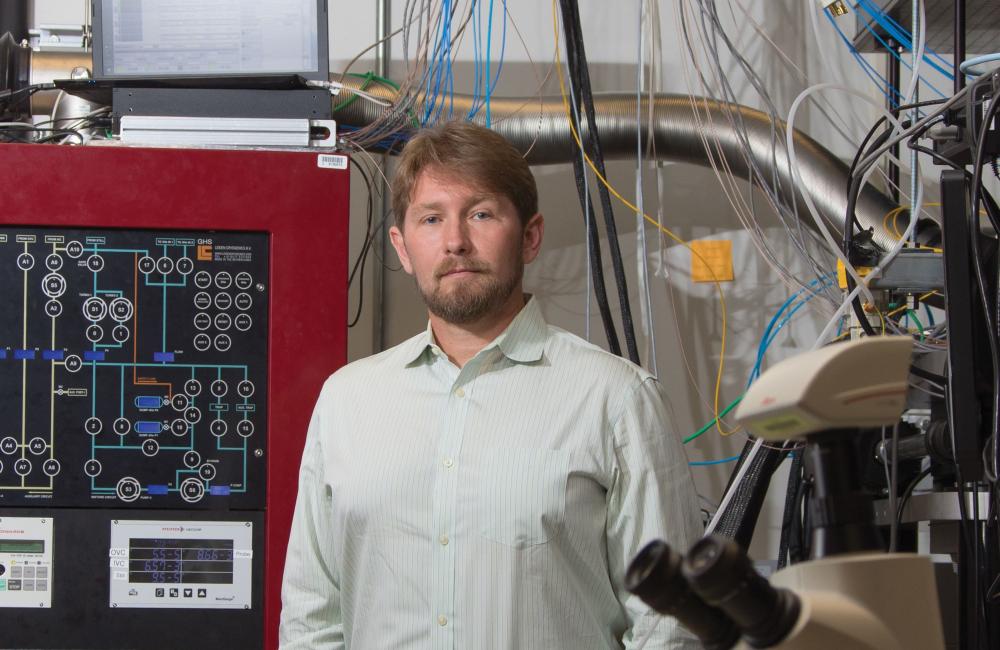
ORNL quantum computing scientist Travis Humble. Image credit: Carlos Jones, ORNL

ORNL’s Clarina dela Cruz uses the lab’s neutron scattering facilities to examine quantum materials. Image credit: Carlos Jones, ORNL
2019: New materials for sensors, computers, encryption and more
Quantum mechanics may give us powerful computers, but that’s not the whole story. Researchers working in the nanoscale world of atoms and molecules are also exploring a variety of materials that show promising, if odd, behaviors because of their quantum mechanical interactions.
2019: Cooking up quantum materials
Before researchers can experiment with a promising new quantum material, someone has to produce it. That’s where ORNL’s Correlated Electron Materials Group comes in. The group uses its lab facilities to manufacture a variety of materials that are attractive to quantum scientists.
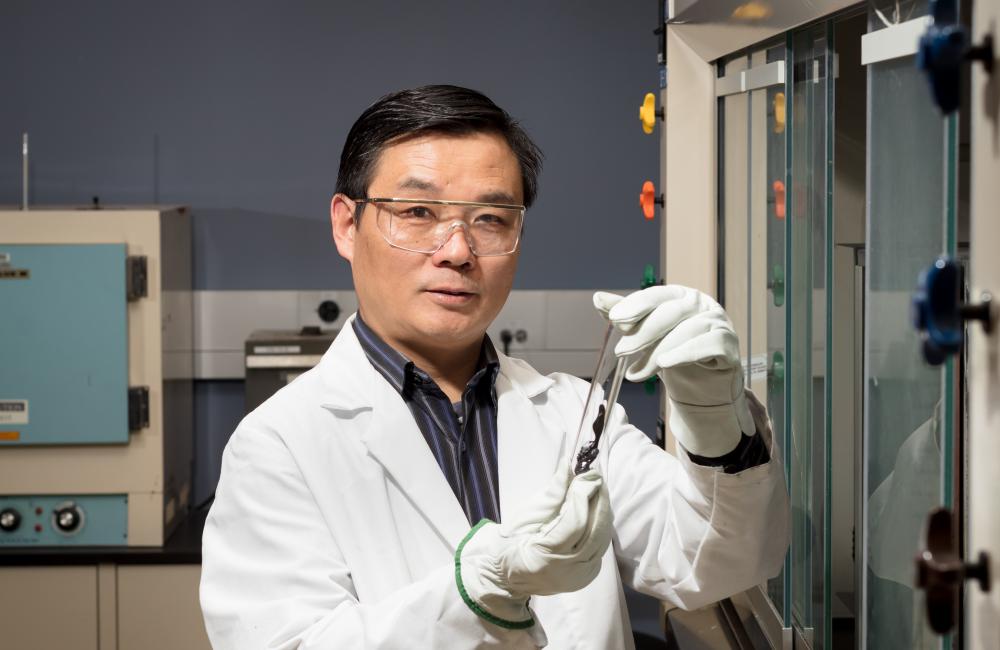
ORNL materials scientist Jiaqiang Yan. Image credit: Carlos Jones, ORNL

2020: Quantum science: Exploring subatomic weirdness (podcast)
Quantum mechanics. Does the term alone make your brain hurt a little? If so, you’re not alone. It’s a very complex branch of physics where things are just kind of … weird. However, it’s this strange behavior particles exhibit at the subatomic scale that has the potential to create a technological revolution in computing, materials, networking, and sensing.
2020: Soundbite: Quantum security for the grid (podcast)
In the last episode, we discussed the strange world of quantum mechanics. The laws of quantum mechanics describe the odd behavior of subatomic particles. Harnessing the power of quantum mechanics could create a technological revolution. While quantum technologies might sound like something out of science fiction, the reality is quantum applications in computing, materials, sensors and networking could have a profound impact on our everyday lives.

Nick Peters and his colleagues apply ORNL’s novel quantum networking technology to the lab’s partnership with EPB Chattanooga.

Researchers developed a quantum light approach for atomic force microscopy that enables measurement of signals otherwise buried by noise.
2020: Quantum light squeezes the noise out of microscopy signals
Researchers at ORNL used quantum optics to advance state-of-the-art microscopy and illuminate a path to detecting material properties with greater sensitivity than is possible with traditional tools.
2021: Key witness helps scientists detect ‘spooky’ quantum entanglement in solid materials
Quantum entanglement occurs when two particles appear to communicate without a physical connection, a phenomenon Albert Einstein famously called “spooky action at a distance.” Nearly 90 years later, a team led by ORNL demonstrated the viability of a “quantum entanglement witness” capable of proving the presence of entanglement between magnetic particles, or spins, in a quantum material.
A material’s spins, depicted as red spheres, are probed by scattered neutrons.

The micro-ring resonator, shown here as a closed loop, generated high-dimensional photon pairs.
2022: New measurements quantifying qudits provide glimpse of quantum future
Using existing experimental and computational resources, a multi-institutional team has developed an effective method for measuring high-dimensional qudits encoded in quantum frequency combs, which are a type of photon source, on a single optical chip.
2023: Breakthroughs in quantum computing, materials, networking, and sensing
By investigating promising quantum hardware architectures and software applications via experiment, theory, and simulation, ORNL researchers are enabling new paradigms of information processing. This effort requires multidisciplinary teams of computer scientists, physicists, and engineers working in concert to advance the field.

A dilution refrigerator run by the Quantum Information Science group. This refrigerator operates at a base temperature of roughly 10 mK.

Scientists have utilized the unique properties of quantum states of light to implement parallel quantum-enhanced sensing.
2024: Researchers reveal quantum advantage that could advance future sensing devices
Researchers from ORNL have taken a major step forward in using quantum mechanics to enhance sensing devices, a new advancement that could be used in a wide range of areas, including materials characterization, improved imaging and biological and medical applications.
2024: New technique could unlock potential of quantum materials
A research team led by ORNL has devised a unique method to observe changes in materials at the atomic level. The technique opens new avenues for understanding and developing advanced materials for quantum computing and electronics.

Electron microscopy measurements are usually made by collecting all points in a 2D grid. Here, only sites of interest are measured (colored circles).

An artistic rendering depicts direct writing using ORNL’s synthescope, a novel microscopy technique, to continuously insert tin atoms into graphene.
2024: ‘Writing’ with atoms could transform materials fabrication for quantum devices
A new technology to continuously place individual atoms exactly where they are needed could lead to new materials for devices that address critical needs for the field of quantum computing and communication that cannot be produced by conventional means, say scientists who developed it.
A research team at ORNL created a novel advanced microscopy tool to “write” with atoms, placing those atoms exactly where they are needed to give a material new properties.
2025: Single-qubit sensing puts new spin on quantum materials discovery
Working at nanoscale dimensions, billionths of a meter in size, a team of scientists led by ORNL revealed a new way to measure high-speed fluctuations in magnetic materials. Knowledge obtained by these new measurements, published in Nano Letters, could be used to advance technologies ranging from traditional computing to the emerging field of quantum computing.
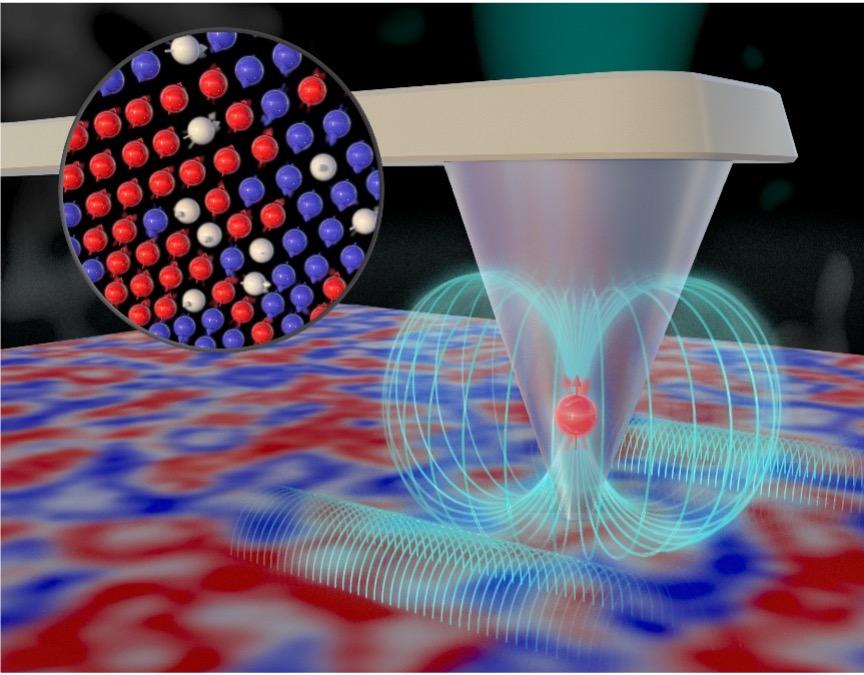
A single-spin qubit probes nanoscale spin fluctuations to reveal magnetic interactions in quantum materials.