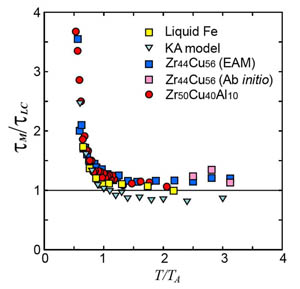
Elementary excitations in metallic liquids were discovered through computer simulation, representing a major advance in the physics of liquids. In solids the elementary excitations of lattice dynamics are phonons, but in liquids they have a very short lifetime. The current work shows that the elementary excitations in liquids are not phonons but local configurational excitations (LCEs), in which an atom loses or gains one nearest neighbor. Molecular dynamics simulations with classical as well as quantum mechanical methods show that the Maxwell relaxation time,
(= viscosity/shear modulus), is equal to the time-scale of LCEs,
, for a number of liquid metal alloys at high temperatures. Thus, these atomic-level excitations directly explain the macroscopic viscous behavior of a liquid. The current work also shows that the equality
=
breaks down below a crossover temperature
above which phonons are localized, and LCEs cannot communicate each other. This discovery will help understanding of the glass transition, which has long been a major mystery [see, e.g., P.W. Anderson,
, 1615 (1995)].
For more information, please contact Takeshi Egami, [email protected].
T. Iwashita, D. M. Nicholson, and T. Egami, Physical Review Letters (in press).