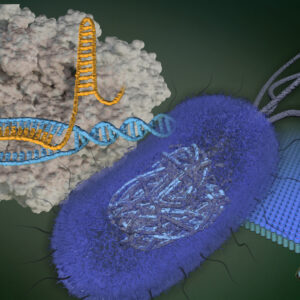
ORNL researchers evaluated nearly 500,000 CRISPR-Cas9 guide RNAs in E. coli and found that more than 93 percent work as intended. Their free gRNA Atlas helps scientists select reliable guides and engineer microbes more efficiently for producing chemicals, materials and medicines.
Researchers at ORNL developed a new electric motor drive design that reduces excess heat, electrical noise and component wear without requiring additional hardware. Simulations showed a 90% reduction in neutral-point voltage fluctuations and a 43% decrease in current stress on capacitors, improving reliability for high-power transportation applications.
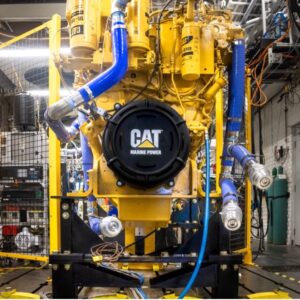
ORNL and Caterpillar developed a dual-fuel combustion system that enables diesel marine engines to run primarily on methanol by using a small amount of diesel as a pilot fuel for ignition. The approach allows engines to operate on more than 75% methanol across a wide range of power levels without sacrificing performance, while requiring only engine modifications rather than a complete redesign.
ORNL researchers developed a compact, high-efficiency power converter using gallium nitride semiconductors instead of traditional silicon. The new technology switches electricity faster with less energy loss, making converters smaller, lighter and more affordable. Researchers say the converters could help meet growing power demands in AI data centers, where large numbers of efficient converters are needed for servers.
Researchers at ORNL developed new experimental methods to measure how uranium-bearing molten salts conduct heat and flow, providing critical data for advancing molten salt reactor technologies. Using specialized tools developed at ORNL, the team generated unique thermal conductivity and viscosity data that will help improve reactor models, support licensing efforts, and expand the Molten Salt Thermal Properties Database.
The 2026 Fuel Economy Guide from the U.S. Department of Energy and Environmental Protection Agency shows that fuel costs depend on more than a vehicle’s make and model, including driving habits and maintenance. It notes that speeding, rapid acceleration and hard braking reduce fuel efficiency, while smoother driving can save money. The guide also helps consumers compare fuel-efficient gasoline, diesel, hybrid and electric vehicles.
Scientists at Oak Ridge National Laboratory are developing AI-enabled pixel detectors that can analyze particle-collision data directly at the source. The approach could help particle-physics experiments identify and capture the most important signals from the enormous amounts of data modern accelerators produce, helping scientists make faster, more informed discoveries from some of the world’s most complex experiments.
ORNL received more than $5 million from DOE;s Technology Commercialization Fund to advance research in grid security, artificial intelligence, nuclear energy and advanced manufacturing, helping move lab innovations toward industry use.
Researchers at ORNL have captured first-of-a-kind optical measurements during accident testing of commercially irradiated nuclear fuel cladding. Using a technique called digital image correlation, the test captured detailed measurements of the cladding’s behavior during a simulated loss-of-coolant accident.
Experiments conducted between 2002 and 2012 at ORNL studied 31 tin isotopes with varying numbers of neutrons to examine how neutrons affect nuclear stability and nuclear properties. The combined results contributed to identifying tin-132 as a doubly magic nucleus and improved theoretical models of nuclear structure.
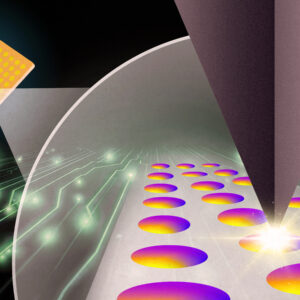
ORNL researchers enhanced atomic force microscopy with machine learning to write and erase nanoscale patterns in ferroic materials. This innovation promises multistate memory capabilities and advances electronic data storage.
A research team led by Oak Ridge National Laboratory has developed a new method to uncover the atomic origins of unusual material behavior. This approach uses Bayesian deep learning, a form of artificial intelligence that combines probability theory and neural networks to analyze complex datasets with exceptional efficiency.