The Department of Energy has committed funding to establish UNITY-3, a fusion breeding blanket test facility at Oak Ridge National Laboratory, in partnership with Kyoto Fusioneering. The facility will test breeding blanket technologies under fusion-like conditions and support research on tritium fuel production, high-energy neutron science and AI-accelerated digital twins.
ORNL has licensed a suite of cryogenic pellet fueling technologies to Type One Energy, advancing a critical capability for high-performance fusion plasma operations. The agreement, signed at the Nuclear Opportunities Workshop (NOW) in Knoxville, Tennessee, outlines the use of four ORNL inventions supporting the design and operation of cryogenic pellet fueling systems.
ORNL and Rutherford Energy Ventures have launched FULCRA, a public-private partnership to develop shared fusion testbed infrastructure and a new model for advancing fusion technologies. The initiative will create a blueprint for shared-use facilities that help validate critical fusion components and accelerate fusion energy commercialization.
Six entrepreneurs have been selected for the next cohort of Innovation Crossroads, a Department of Energy Lab-Embedded Entrepreneurship Program node based at Oak Ridge National Laboratory. The program provides energy-related startup founders from across the nation with access to ORNL’s researchers, facilities and technical expertise, as well as connect them with experts, mentors and networks to accelerate their efforts to take their promising ideas to the marketplace.
Sam Hurst was a pioneering ORNL physicist and inventor who helped develop resistive touchscreen technology, laying the foundation for the touchscreens used in modern devices. He earned more than 30 patents, founded four companies, and played a key role in strengthening the long-standing partnership between ORNL and the University of Tennessee.
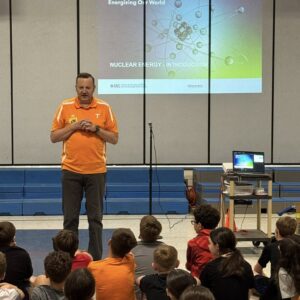
ORNL scientists partnered with Kingston Elementary School to host a Nuclear Day, introducing fifth-grade students to nuclear science through hands-on activities and interactive demonstrations. The event engaged students in topics such as radiation, uranium enrichment, nuclear reactors and chain reactions, inspiring curiosity about STEM careers and highlighting the role of nuclear science in everyday life.
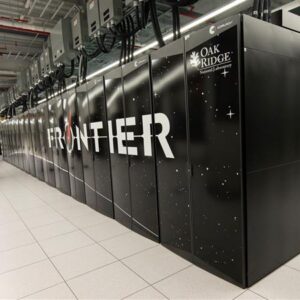
Researchers used the world’s fastest supercomputer for open science to train an artificial intelligence model that captures magnetic turbulence within a plasma in unprecedented detail. Results from the model could support research ranging from modeling a supernova to building the next generation of nuclear fusion reactors.
ORNL researchers developed a machine learning model that generates realistic tungsten microstructure images, helping fill gaps in costly experimental data. The approach supports virtual experiments to design more durable fusion reactor components and reduce maintenance costs.
Rinkle Juneja, an R&D staff scientist at ORNL, has been recognized as an Early Career Distinguished Presenter by the Materials Research Society and was selected to represent ORNL on the “Materials Research at the U.S. DOE National Laboratories” panel at the MRS Fall Meeting.
Researchers at ORNL are helping to enable the next generation of abundant, affordable nuclear energy by combining 80 years of know-how with the latest scientific techniques, facilities and equipment. The lab’s longstanding expertise in degradation of materials in the harsh environments of nuclear reactors make it the go-to place for a resurgence of interest in liquid metals and molten salts for both advanced fission and fusion reactors.
ORNL is partnering with Kyoto Fusioneering on a new public-private partnership that leverages each institution’s expertise in fusion technology to develop world-leading fusion test facilities and technology and accelerate the deployment of commercial fusion power.
ORNL, Type One Energy and the University of Tennessee, Knoxville, are partnering to establish a world-class facility that will drive American innovation and move fusion energy closer to reality. This high-heat flux facility, located in TVA’s Bull Run site in East Tennessee, will evaluate how materials react under extreme conditions in a fusion device.