John Lajoie, a physicist at ORNL, develops advanced particle detectors that help scientists study the fundamental structure of matter while often enabling innovations in other scientific fields. As spokesperson for the ePIC Collaboration, he is helping design the detector for the future Electron-Ion Collider, which will use cutting-edge detector technology, streaming data, and AI to explore how quarks and gluons shape protons, neutrons, and nuclear matter.
Oak Ridge National Laboratory is advancing nuclear battery technology to provide reliable, long-lasting power for remote and extreme environments, from deep space to national security applications. ORNL researchers are exploring new radioisotope fuels, more efficient energy conversion, improved thermal management and advanced manufacturing to make nuclear batteries safer, more efficient and easier to deploy.
Behind every self-driving laboratory at ORNL is a team most people never see. Facilities and Operations workers are building and maintaining the infrastructure that makes autonomous science possible.
Researchers at ORNL’s Center for Nanophase Materials Sciences are developing autonomous workflows that combine advanced instruments, AI, simulations and theory to accelerate microelectronics research. These systems can interpret experimental data in real time, guide next steps during materials synthesis and analysis, and help scientists better understand and optimize next-generation materials for memory devices and transistors.
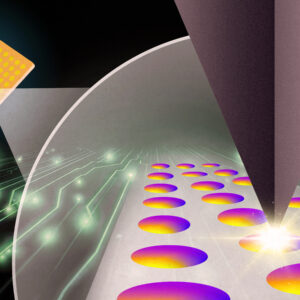
ORNL scientists demonstrated a new way to make aluminum nitride store data using far less energy by creating controlled defects with a focused helium ion beam. The approach reduced the energy needed for polarization switching by about 40% and could support more efficient memory and wireless communication devices using existing chip manufacturing methods.
Yongtao Liu is an R&D staff member at Oak Ridge National Laboratory’s Center for Nanophase Materials Sciences (CNMS). In the Data NanoAnalytics Group, he is helping nanomaterials research move toward experiments that can run with far less handholding.
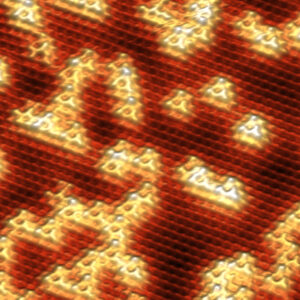
Researchers at ORNL, working with international partners, have uncovered surprising behavior in a specially engineered crystal. Composed of tantalum, tungsten and selenium, the crystal demonstrates an unexpected atomic arrangement that hints at novel applications in spin-based electronics and quantum materials.
ORNL researchers enhanced atomic force microscopy with machine learning to write and erase nanoscale patterns in ferroic materials. This innovation promises multistate memory capabilities and advances electronic data storage.
Five breakthrough simulation projects conducted on the Frontier supercomputer at ORNL have been named finalists for the Association for Computing Machinery’s Gordon Bell Prize. Four of the projects are in the running for the main prize and one project is contending for a special prize.
Researchers Sang-Ho Kim, An-Ping Li, Bronson Messer and Zac Ward of ORNL have been named Fellows of the American Physical Society in recognition of their outstanding impact in their respective fields.
Researchers with the Department of Energy’s Oak Ridge National Laboratory and the University of Tennessee, Knoxville, have created an innovative method to visualize and analyze atomic structures within specially designed, ultrathin bilayer 2D materials. When precisely aligned at an angle, these materials exhibit unique properties that could lead to advancements in quantum computing, superconductors and ultraefficient electronics.
A research team led by Oak Ridge National Laboratory has developed a new method to uncover the atomic origins of unusual material behavior. This approach uses Bayesian deep learning, a form of artificial intelligence that combines probability theory and neural networks to analyze complex datasets with exceptional efficiency.