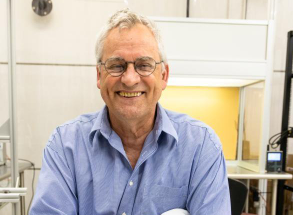
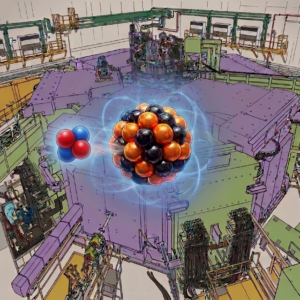
John Lajoie, a physicist at ORNL, develops advanced particle detectors that help scientists study the fundamental structure of matter while often enabling innovations in other scientific fields. As spokesperson for the ePIC Collaboration, he is helping design the detector for the future Electron-Ion Collider, which will use cutting-edge detector technology, streaming data, and AI to explore how quarks and gluons shape protons, neutrons, and nuclear matter.
Oak Ridge National Laboratory is advancing nuclear battery technology to provide reliable, long-lasting power for remote and extreme environments, from deep space to national security applications. ORNL researchers are exploring new radioisotope fuels, more efficient energy conversion, improved thermal management and advanced manufacturing to make nuclear batteries safer, more efficient and easier to deploy.
Researchers at ORNL and the University of Tennessee, Knoxville, demonstrated an AI-driven workflow that guided data collection in real time during a beamline experiment at Cornell University's CHESS facility. The approach allowed the AI to adjust measurements as data was collected, advancing autonomous scientific research and supporting DOE's Genesis Mission.
Caleigh Samuels of ORNL has received the 2026 Elda E. Anderson Award from the Health Physics Society for her research excellence and contributions to radiation protection. She leads radiation dosimetry efforts at ORNL's Center for Radiation Protection Knowledge and supports national and international radiation safety initiatives.
David Radford has built his career on helping his fellow scientists see what would otherwise remain invisible. A nuclear physicist at the U.S. Department of Energy’s Oak Ridge National Laboratory, Radford specializes in creating exquisitely sensitive detectors to peer into the mysteries of the atomic nucleus, thereby illuminating the nature of matter.
Oak Ridge National Laboratory’s OLCF provided a Lawrence Berkeley National Laboratory scientist with remote access to an IBM quantum computer through its Quantum Computer User Program (QCUP) to simulate hadronization, a key process in particle physics. The project reproduced results from previous classical simulations using a simplified quantum mechanical model and serves as a step toward using quantum computers for larger quantum chromodynamics calculations.
Researchers from ORNL and international collaborators discovered a simpler, lower-pressure method to produce R8 silicon, a rare form of silicon with promising applications in energy storage and electronics. By compressing amorphous (glassy) silicon instead of crystalline silicon, the team created R8 more efficiently, with neutron scattering, X-ray diffraction, and computer modeling confirming the process and suggesting it could also work for other materials like germanium.
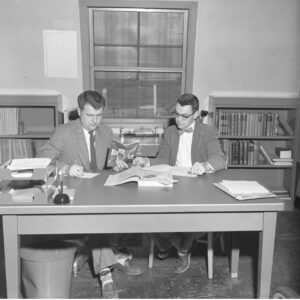
Sam Hurst was a pioneering ORNL physicist and inventor who helped develop resistive touchscreen technology, laying the foundation for the touchscreens used in modern devices. He earned more than 30 patents, founded four companies, and played a key role in strengthening the long-standing partnership between ORNL and the University of Tennessee.
Scientist Jason Newby measures phenomena that have never been observed, including a neutrino bouncing off an atomic nucleus — a signal as subtle as the tiny recoil of a bowling ball struck by a ping-pong ball. Capturing that effect is the kind of precision physics at the heart of a world-class research program Newby helped build at ORNL.
Physicists at the University of Tennessee, Knoxville and researchers at ORNL have made critical measurements of the lifetime and decay energy of tellurium-104, an important step in answering a century-old question and understanding how hundreds
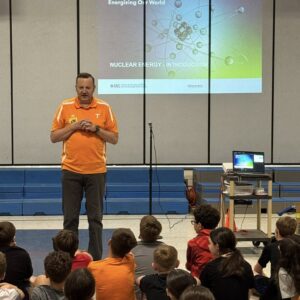
ORNL scientists partnered with Kingston Elementary School to host a Nuclear Day, introducing fifth-grade students to nuclear science through hands-on activities and interactive demonstrations. The event engaged students in topics such as radiation, uranium enrichment, nuclear reactors and chain reactions, inspiring curiosity about STEM careers and highlighting the role of nuclear science in everyday life.
Scientists at Oak Ridge National Laboratory are developing AI-enabled pixel detectors that can analyze particle-collision data directly at the source. The approach could help particle-physics experiments identify and capture the most important signals from the enormous amounts of data modern accelerators produce, helping scientists make faster, more informed discoveries from some of the world’s most complex experiments.