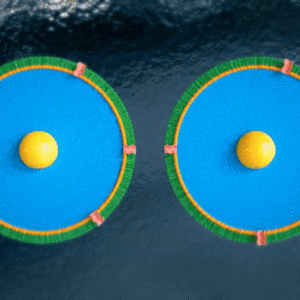
ORNL researchers found that lipid bilayers, the basic structure of cell membranes, can exhibit electrical behaviors associated with learning and memory. The discovery could advance brain-inspired computing technologies and provide new insights into neurological disorders.
Researchers from ORNL and international collaborators discovered a simpler, lower-pressure method to produce R8 silicon, a rare form of silicon with promising applications in energy storage and electronics. By compressing amorphous (glassy) silicon instead of crystalline silicon, the team created R8 more efficiently, with neutron scattering, X-ray diffraction, and computer modeling confirming the process and suggesting it could also work for other materials like germanium.
ORNL had a major presence at the 2026 AI+ Expo for National Competitiveness with multiple ORNL researchers presenting and demoing their latest work. Hosted by the Special Competitive Studies Project, the event brought together leaders from technology, academia, industry and government to discuss the rapidly evolving role of artificial intelligence in advancing U.S. innovation, energy resilience, competitiveness and national security.
Igor Remec of ORNL was named a Fellow of the American Nuclear Society, the organization’s highest honor, for his decades of contributions to nuclear safety, neutron science, and the development of ORNL’s Second Target Station.
A small team at Oak Ridge National Laboratory keeps the Spallation Neutron Source running around the clock, ensuring a powerful accelerator produces neutrons for cutting-edge research. Their work supports scientists worldwide studying materials, energy, and advanced technologies.
ORNL researchers combined the SAMMY code with VENUS neutron imaging to identify nuclear materials without damaging them. The method uses precise data and modeling to distinguish complex isotopes. Tests on gold, tantalum and hafnium showed it can accurately match nuclear “fingerprints.”
Performing neutron experiments at the Spallation Neutron Source delivers even better data in less time, now that the SNS linear accelerator, or linac, is well along the path to 2.8 megawatts – double its original proton power level. The additional power is thanks to the Proton Power Upgrade project, which has paved the way for constructing the planned Second Target Station, and is already helping accelerate the pace of scientific discovery across a wide range of materials and technologies at the First Target Station.
Click here to read the static version. On a clear April day in 2006, a team of engineers and scientists erupted with excitement from the control room of the Spallation Neutron Source (SNS), a newly built user facility at Oak Ridge National Laboratory. A pulse of protons — racing at nearly the speed of light — shot
ORNL’s VENUS neutron imaging instrument has begun user operations, delivering its first results at the Spallation Neutron Source. Early tests showed faster, more precise 3D imaging, advancing materials research and neutron science.
SNS celebrates 20 years of scientific achievements enabled by safe, reliable operations driven by its target system. Since coming online in 2006, SNS has celebrated many milestones, including being the first to successfully incorporate a liquid mercury target. This feature discusses the plans to incorporate artificial intelligence to support the target as well as what is next for the second target station.
Researchers at ORNL developed a method to convert a commonly discarded hydrocarbon polymer into gasoline- and diesel-like fuels. The team has applied for a patent for the discovery, which treats polyethylene — the stuff of white cutting boards and shopping bags — with aluminum chloride-containing molten salts that serve as both solvent and catalyst. If scaled beyond the laboratory, the process could strengthen U.S. energy security and industrial competitiveness.
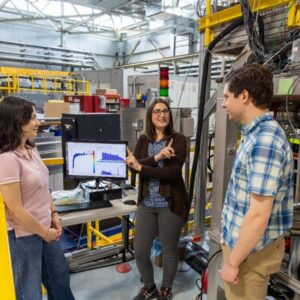
Leah Broussard, a research scientist in the Physics Division at ORNL, has received the inaugural DOE Distinguished Mentor Award for Workforce Development, recognizing scientists who guide and support the next generation of researchers.