Click here for static version. What if one answer to the supply crisis isn’t buried in a mine shaft, but growing quietly in a field? For too long, the United States has relied on foreign sources for most of the raw materials powering its technological future, the essential minerals in every smartphone, battery pack and
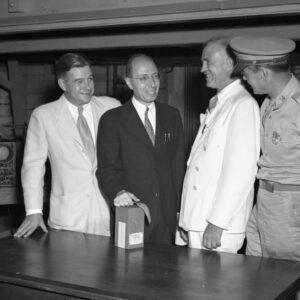
On Aug. 2, 1946, as newspaper reporters crowded the stage, scientists at Clinton Laboratories in Oak Ridge, Tennessee, made a ceremony of the very first official shipment of a reactor-created radioisotope. Carbon-14, a medical isotope, was sent to the Barnard Free Skin and Cancer Hospital in St. Louis, Missouri, from what would become the Department
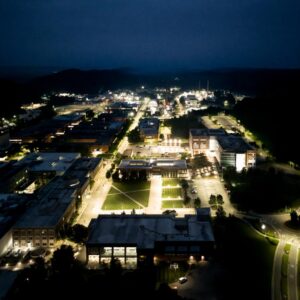
It’s a typical weekday, and the Department of Energy’s Oak Ridge National Laboratory buzzes with activity. Its 7,400 employees move across the 4,400-acre campus. Thousands of visiting scientists cycle through its user facilities. Roads hum with traffic. As night falls, the energy doesn’t disappear — but it changes. Buildings go dark and parking lots empty.
Click here to read the static version. On a clear April day in 2006, a team of engineers and scientists erupted with excitement from the control room of the Spallation Neutron Source (SNS), a newly built user facility at Oak Ridge National Laboratory. A pulse of protons — racing at nearly the speed of light — shot
Key Points Click here to read a static version. Somewhere in America, a patient with cancer participating in a clinical trial receives an experimental drug — a treatment built on the hope of attacking tumors while leaving healthy tissue unharmed. The key to the drug is actinium-225, a radioactive isotope produced at the Department of
Click here to read a static version. In fall 2020, California-based Kairos Power announced plans to build an advanced nuclear demonstration reactor within the site of the former K-25 uranium enrichment plant in Oak Ridge. It was a good location for the company. The decommissioned K-25, now named Heritage Center Industrial Park, came with impressive
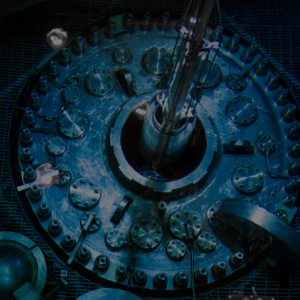
Click here to read a static version. As night descends on the Department of Energy’s Oak Ridge National Laboratory, the High Flux Isotope Reactor (HFIR) bursts with activity. A rigorous 24-day fuel cycle concludes and neutron production pauses at the lab’s research reactor where neutrons help unravel the secrets of materials and energy. The reactor
Key Points Click here to read a static version. Of all areas of science, quantum mechanics — which studies the eccentric behavior of matter at its smallest scales — is perhaps the most perplexing. In this microscopic world, the term “particle” takes on a new meaning, with electrons, photons and the like behaving sometimes like particles
Click here to read a static version. In an autonomous chemistry laboratory on Oak Ridge National Laboratory’s main campus, a mobile robot shuttles between workstations, most of which have their own robots. Guided by advanced artificial intelligence, the equipment — much of it custom-built — grabs chemicals and mixes them together. Sometimes it heats the
Click here to read a static version. In the good old days of the early ’90s, the internet promised to make the world and its then-five and a half billion people better. By giving us equal access to the world’s information, it was going to democratize knowledge. By giving us all the ability to make
Click here to read a static version. The geology along Ecuador’s Coca River is moving in fast-forward. In a scientific field where natural wonders form over millennia, but natural disasters occur in minutes, speed is less than desirable. Over the last four years, the river and its surrounding area within the Amazon basin have experienced
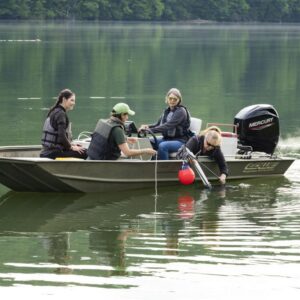
For aquatic ecologist, Natalie Griffiths, the workday starts early with a boat ride across the blue waters of Douglas Lake, one of East Tennessee’s largest reservoirs. She’s on a sampling run with fellow researchers from the Department of Energy’s Oak Ridge National Laboratory. The group is checking a series of traps set at different depths