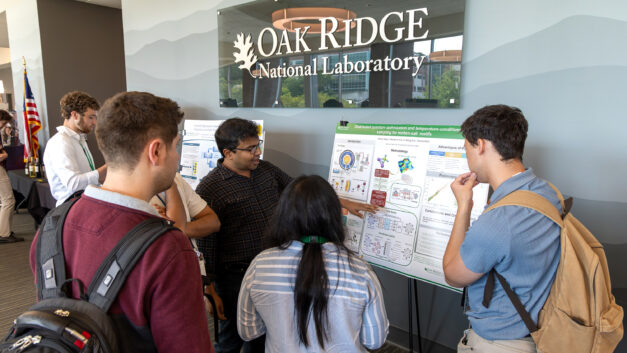
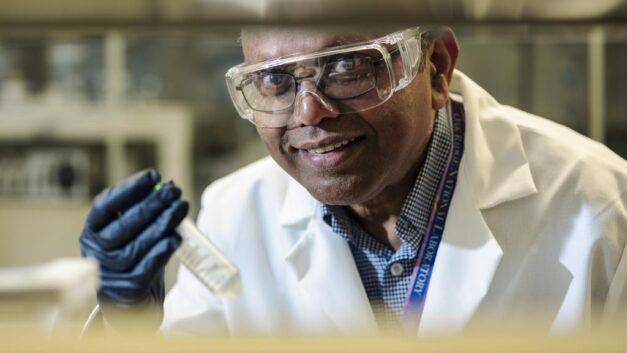
ORNL researchers developed an agentic AI co-scientist that analyzes plant experiments to accelerate phytomining research and support domestic critical mineral recovery. As part of DOE's Genesis Mission OPAL project, the system reduced analysis time for more than 1,000 plant traits from hundreds of hours to a few minutes.
ORNL’s High Flux Isotope Reactor offers flexible testing, advanced instrumentation and on-site facilities to accelerate nuclear fuel development. Its capabilities provide critical data needed to qualify new fuels and support advanced reactor deployment.
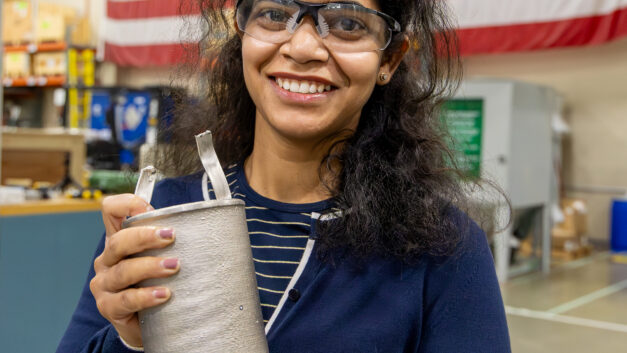
ORNL researchers have developed a hybrid manufacturing method that combines 3D printing and electroforming to create leak-free HIP cans for advanced nuclear reactor components. The approach could simplify production of complex metal parts, reduce costs and reliance on overseas manufacturing, and strengthen U.S. supply chains for nuclear energy and defense applications.
Nine Innovation Crossroads companies pitched their technologies during ORNL’s Materials and Manufacturing Innovation Days (M2IND) Aug. 19–20. The event brought together leaders from industry, government, academia and the national laboratory system for demonstrations, facility tours, discussions and partnership announcements.
ORNL researchers evaluated nearly 500,000 CRISPR-Cas9 guide RNAs in E. coli and found that more than 93 percent work as intended. Their free gRNA Atlas helps scientists select reliable guides and engineer microbes more efficiently for producing chemicals, materials and medicines.
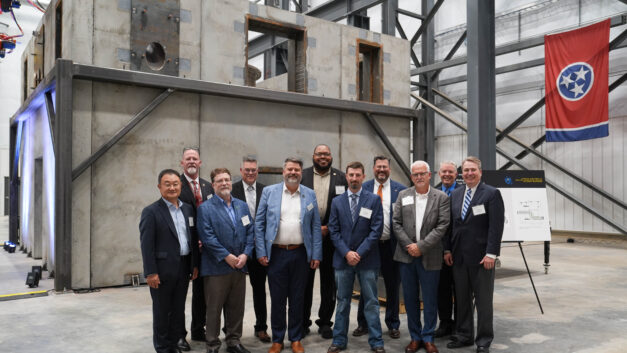
Kairos Power announced the Nuclear Center for Advanced Manufacturing and Precast, an initiative focused on maturing new manufacturing and construction methods and developing vocational training for skilled workers in East Tennessee to support the deployment of advanced nuclear reactors.
ORNL and Idaho National Laboratory are collaborating to advance wire arc 3D printing of large pressure vessels and strengthen the domestic nuclear manufacturing supply chain. The labs will combine advanced manufacturing, AI and data science to accelerate the production and qualification of critical nuclear components.
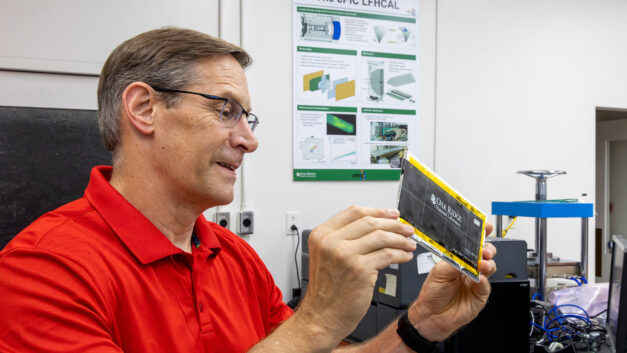
John Lajoie, a physicist at ORNL, develops advanced particle detectors that help scientists study the fundamental structure of matter while often enabling innovations in other scientific fields. As spokesperson for the ePIC Collaboration, he is helping design the detector for the future Electron-Ion Collider, which will use cutting-edge detector technology, streaming data, and AI to explore how quarks and gluons shape protons, neutrons, and nuclear matter.
ORNL’s seventh annual Quantum Computing User Forum brought together 184 researchers, developers and industry leaders to showcase advances in quantum applications, software, and hybrid quantum-HPC computing enabled through QCUP. The event also strengthened collaborations across the quantum community and highlighted ORNL’s role in developing the technologies, software ecosystem and workforce needed to make quantum computing a practical tool for scientific discovery.
ORNL and KVA Stainless completed a DOE-funded study validating the performance of welded Grade 91 steel for use in high-temperature energy systems. The results will help KVA refine its advanced welding technology and support the development of durable materials for future fission and fusion reactors.
Oak Ridge National Laboratory is advancing nuclear battery technology to provide reliable, long-lasting power for remote and extreme environments, from deep space to national security applications. ORNL researchers are exploring new radioisotope fuels, more efficient energy conversion, improved thermal management and advanced manufacturing to make nuclear batteries safer, more efficient and easier to deploy.