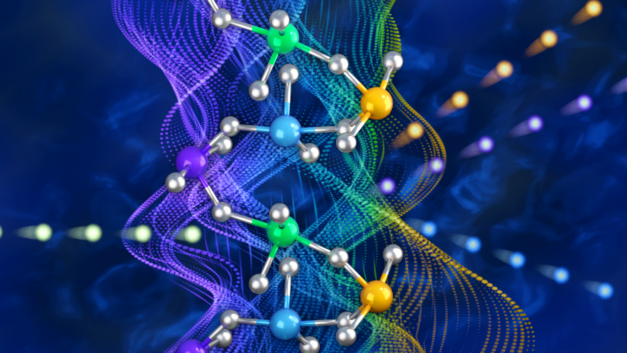
New research from ORNL, in collaboration with The Ohio State University and Amphenol Corporation, challenges conventional understanding about controlling heat flow in solid materials.
Scientific Achievement: Inelastic neutron scattering reveals a large electric-field-driven increase in thermal conductivity controlled by increased phonon lifetimes in a relaxor-based ferroelectric.Significance and Impact: This research paves the way for developing solid-state thermal switching devices that enhance energy efficiency over a broad range of temperatures.DOI: 10.1103/5d1z-wg4p
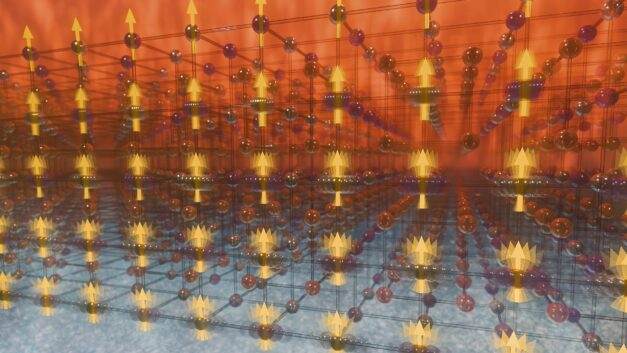
Scientific Achievement: Neutron and X-ray scattering show that bulk RuO₂ exhibits a highly correlated ground state without magnetic moments, despite prior claims of altermagnetism.Significance and Impact: Experimentally-constrained models that decouple electronic correlations from spins emerge that will guide the understanding of correlations in spintronics materials.DOI: 10.1016/j.xcrp.2025.102852
A research team led by ORNL has bridged a knowledge gap in atomic-scale heat motion. This new understanding holds promise for enhancing materials to advance an emerging technology called solid-state cooling.
Scientific Achievement: Neutron scattering uncovered local magnon-phonon hybrid modes that triple cooling capacity of a magnetic shape memory alloy. Significance and Impact: This research reveals a path to develop better materials for solid-state cooling applications, which supports the societal need for cleaner, more efficient technologies.DOI: 10.1126/sciadv.adn2840
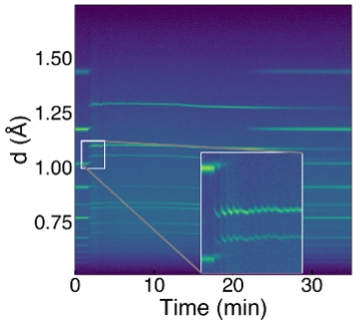
Scientific Achievement: Neutron diffraction and x-ray spectroscopies showed that fine-tuning oxygen content using metal oxalate precursors and MnO2 as oxygen generator stabilizes divalent iron and manganese in a rock-salt high entropy oxide (HEO).Significance and Impact: Demonstrating the stability of divalent Fe in a rock-salt HEO provides a pathway toward novel crystalline materials with targeted cation disorder. DOI: 10.1126/sciadv.adi8809
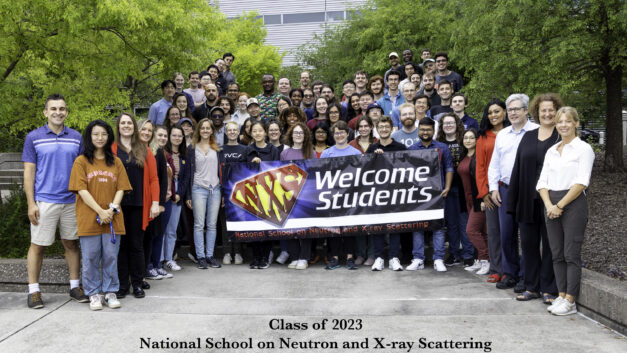
In 2023, the National School on X-ray and Neutron Scattering, or NXS, marked its 25th year during its annual program, held August 6–18 at the Department of Energy’s Oak Ridge and Argonne National Laboratories.
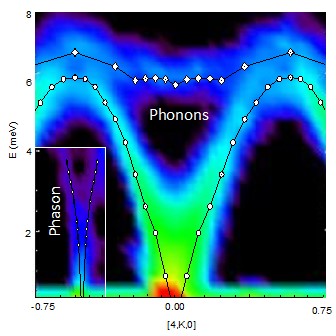
Warming a crystal of the mineral fresnoite, ORNL scientists discovered that excitations called phasons carried heat three times farther and faster than phonons, the excitations that usually carry heat through a material.
Scientific Achievement: Neutron scattering and thermal transport measurements reveal that phasons in piezoelectric fresnoite carry more heat than phonons by propagating farther and faster.Significance and Impact: Understanding thermal conductivity in incommensurate crystals is important for many energy materials, so finding that phasons – which are often ignored – can dominate thermal conductivity in such systems is an important development.DOI: 10.1103/PhysRevLett.129.255901
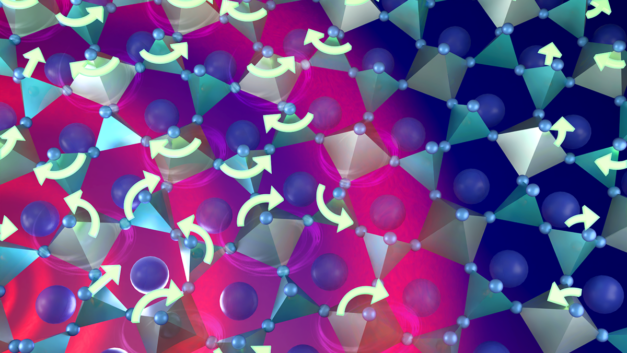
Scientific Achievement: First-principles simulations and neutron scattering reveal conservation of hidden angular momenta for electrons and phonons in materials with structural twisting of coupled rotations and translations. Significance and Impact: Symmetry-derived global rules advance understanding of quasiparticle interactions and topologies toward discovery of materials with novel functionalities.DOI: 10.1016/j.mtphys.2021.100548
Scientific Achievement: Neutron scattering and atomic dynamics simulations reveal that complex crystals can conduct heat like a glass through diffusive quantum hopping. Significance and Impact: The revealed strategies will enable the down-tuning of amorphous-like heat conductivity for energy conversion and thermal barriers, unlocking untapped efficiencies.DOI: 10.1016/j.mtphys.2021.100344