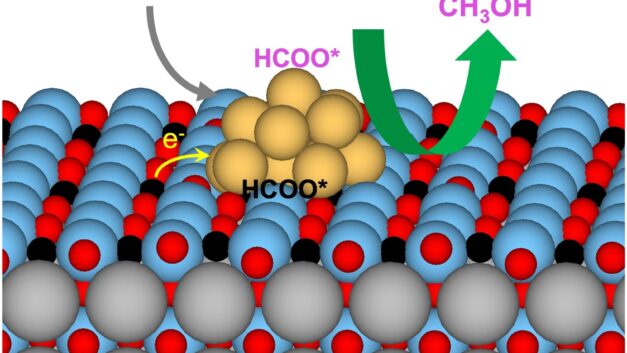
Scientific Achievement: Exsolution behavior in high-entropy oxides (HEOs) were rationally tuned through coupled lattice- and valence-engineering, resulting in a highly active and selective catalyst for acetylene semi-hydrogenation to ethylene.Significance and Impact: This work establishes entropy-enabled lattice and valence engineering as a facile route to programmable exsolution for enhanced catalysis in diverse processes such as dry reforming of methane or reduction of alkynes to olefins.DOI: 10.1002/anie.9920205
ORNL had a major presence at the 2026 AI+ Expo for National Competitiveness with multiple ORNL researchers presenting and demoing their latest work. Hosted by the Special Competitive Studies Project, the event brought together leaders from technology, academia, industry and government to discuss the rapidly evolving role of artificial intelligence in advancing U.S. innovation, energy resilience, competitiveness and national security.
Scientific Achievement: Neutron and X-ray scattering show that bulk RuO₂ exhibits a highly correlated ground state without magnetic moments, despite prior claims of altermagnetism.Significance and Impact: Experimentally-constrained models that decouple electronic correlations from spins emerge that will guide the understanding of correlations in spintronics materials.DOI: 10.1016/j.xcrp.2025.102852
A team of scientists led by ORNL found an unconventional way to improve catalysts made of more than one material. The solution demonstrates a path to designing catalysts with greater activity, selectivity and stability.
The 2023 top science achievements from HFIR and SNS feature a broad range of materials research published in high impact journals such as Nature and Advanced Materials.
Scientists have long sought to better understand the “local structure” of materials, meaning the arrangement and activities of the neighboring particles around each atom. In crystals, which are used in electronics and many other applications, most of the atoms form highly ordered lattice patterns that repeat. But not all atoms conform to the pattern.
Neutron scattering techniques were used as part of a study of a novel nanoreactor material that grows crystalline hydrogen clathrates, or HCs, capable of storing hydrogen.
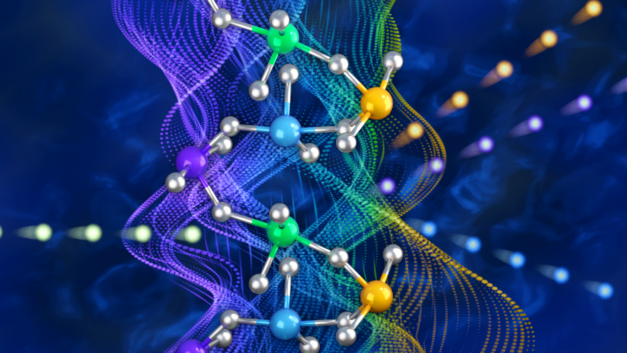
Scientific Achievement: First-principles simulations and neutron scattering reveal conservation of hidden angular momenta for electrons and phonons in materials with structural twisting of coupled rotations and translations. Significance and Impact: Symmetry-derived global rules advance understanding of quasiparticle interactions and topologies toward discovery of materials with novel functionalities.DOI: 10.1016/j.mtphys.2021.100548
Scientific Achievement: Researchers discovered that Li infiltration in solid oxide electrolytes for all-solid-state batteries is associated with local electronic structure at grain boundaries (GBs) rather than exclusively at Li-electrolyte interfaces as in Li-ion batteries.Significance and Impact: Results identify that tailoring GBs with sufficient electronic resistivity is a promising route to mitigate Li dendrite formation in polycrystalline solid electrolytes.DOI: 10.1038/s41563-021-01019-x