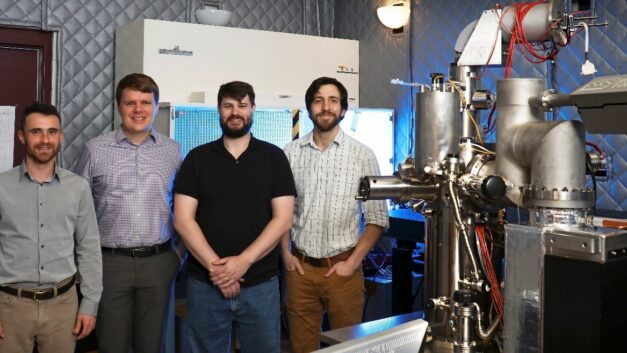
Since its inception in 2010, the program bolsters national scientific discovery by supporting early career researchers in fields pertaining to the Office of Science.
Scientific Achievement: Twin boundaries in FeSe preferentially attract superconducting vortices. The resulting incommensurate potential produces regular 2D and 1D vortex lattices, precisely variable intervortex distance, and profound geometric size effects.Significance and Impact: Control over vortex interactions is crucial to quantum information devices. Our findings open an intrinsic path to control of vortex geometry, bypassing damaging lithography in favor of topological defects and self-organization.DOI: 10.1021/acs.nanolett.3c00125
In the early 2000s, high-performance computing experts repurposed GPUs — common video game console components used to speed up image rendering and other time-consuming tasks
Computer scientists at Oak Ridge National Laboratory have developed an open source software platform that allows quantum programs to run on multiple quantum computers regardless of their unique architecture.
Scientists at the Department of Energy’s Oak Ridge National Laboratory are the first to successfully simulate an atomic nucleus using a quantum computer. The results, published in Physical Review Letters, demonstrate the ability of quantum systems to compute nuclear ph...
Scientists at the Department of Energy’s Oak Ridge National Laboratory are conducting fundamental physics research that will lead to more control over mercurial quantum systems and materials. Their studies will enable advancements in quantum computing, sensing, simulation, and mater...