Researchers Sang-Ho Kim, An-Ping Li, Bronson Messer and Zac Ward of ORNL have been named Fellows of the American Physical Society in recognition of their outstanding impact in their respective fields.
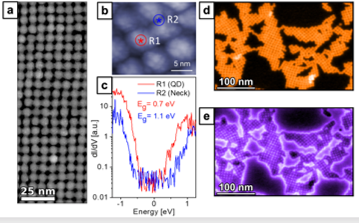
Quantum computers process information using quantum bits, or qubits, based on fragile, short-lived quantum mechanical states. To make qubits robust and tailor them for applications, researchers from the Department of Energy’s Oak Ridge National Laboratory sought to create a new material system.
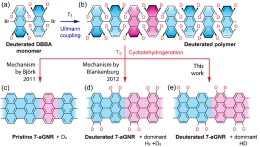
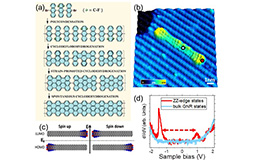
Understanding the reaction mechanisms of dehydrogenative Caryl–Caryl coupling is the key to directed formation of p-extended polycyclic aromatic hydrocarbons.
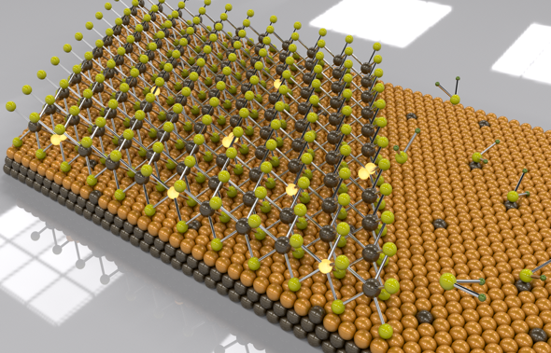
Scientific Achievement: Antisite defects were selectively incorporated in monolayer WS2 during its growth by regulating W diffusion in Au substrates, as predicted by first principles calculations. Significance and Impact: This synthesis strategy to deliberately control defect structures in emerging 2D materials may enable the development of novel quantum materials for next-generation photonics and spintronics.DOI: 10.1002/adma.202106674
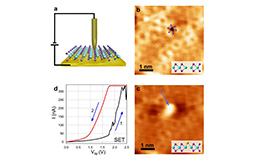
Non-volatile resistive switching (NVRS) where an electric field switches the resistance states of a two-terminal device, has emerged as an important concept in the development of high-density information storage, computing, and reconfigurable systems.
Oak Ridge National Laboratory’s Center for Nanophase Materials Sciences contributed to a groundbreaking experiment published in Science that tracks the real-time transport of individual molecules.
An international multi-institution team of scientists has synthesized graphene nanoribbons – ultrathin strips of carbon atoms – on a titanium dioxide surface using an atomically precise method that removes a barrier for custom-designed carbon