Overview/Objective
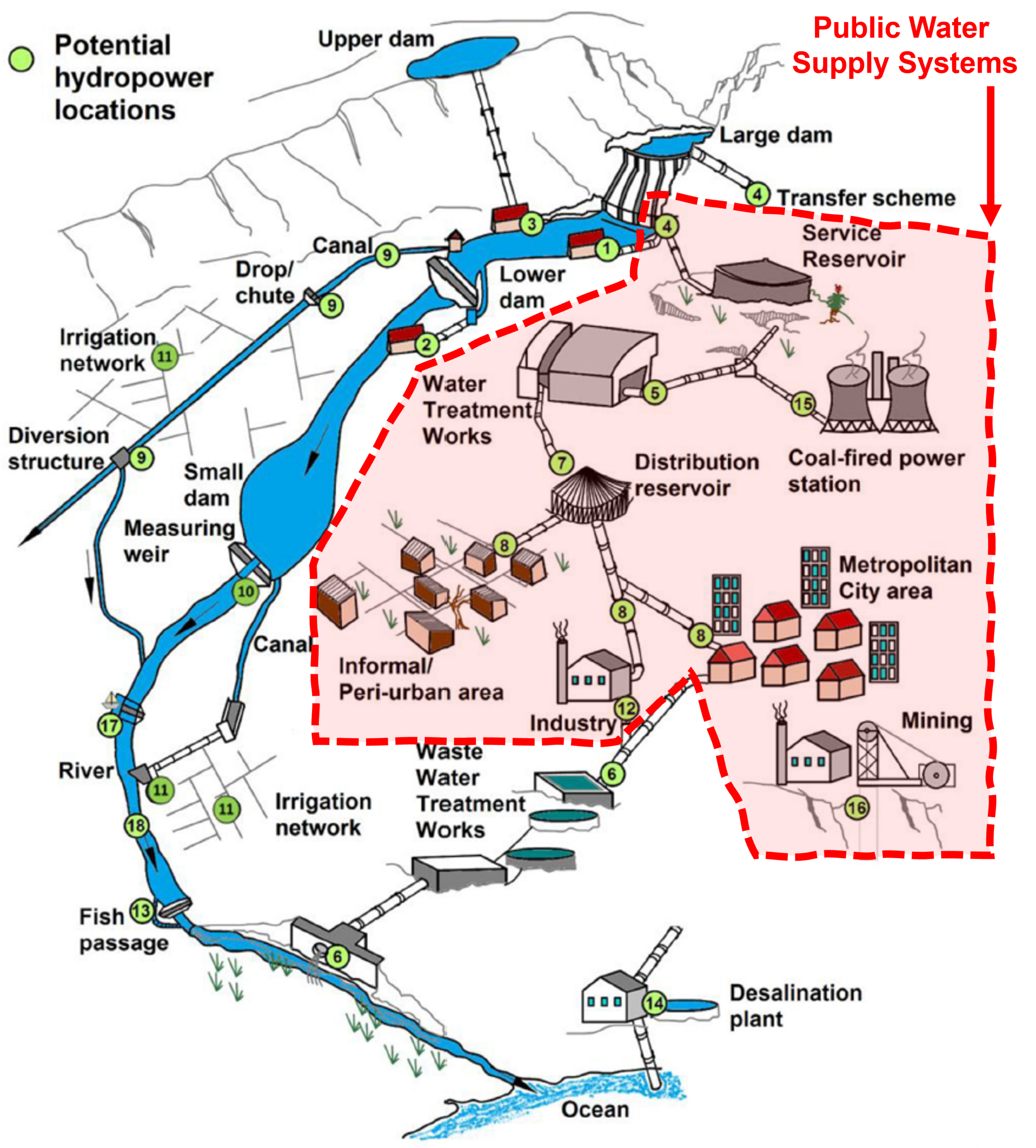
The Conduit Hydropower Engineering, Evaluation, and Technology Acceleration (CHEETA) project seeks to improve deployment potential for conduit hydropower, following on the outcomes of Oak Ridge National Laboratory’s 2022 national conduit hydropower resource assessment, which identified over 1,400 megawatts of total power potential in the U.S. across municipal, agricultural, and industrial conduit systems. While this existing water infrastructure can provide reliable small hydropower production, it is an underutilized resource that has not been fully captured. The U.S. Department of Energy (DOE) has funded ORNL to improve deployment potential for conduit hydropower through the CHEETA project, which has thus far focused on “in-conduit” hydropower (ICH)—or “in-pipe” hydropower—for public water supply (PWS) systems, though the project is planning to cover conduit hydropower more broadly, in particular the municipal and industrial conduit sectors (shown in the figure below).
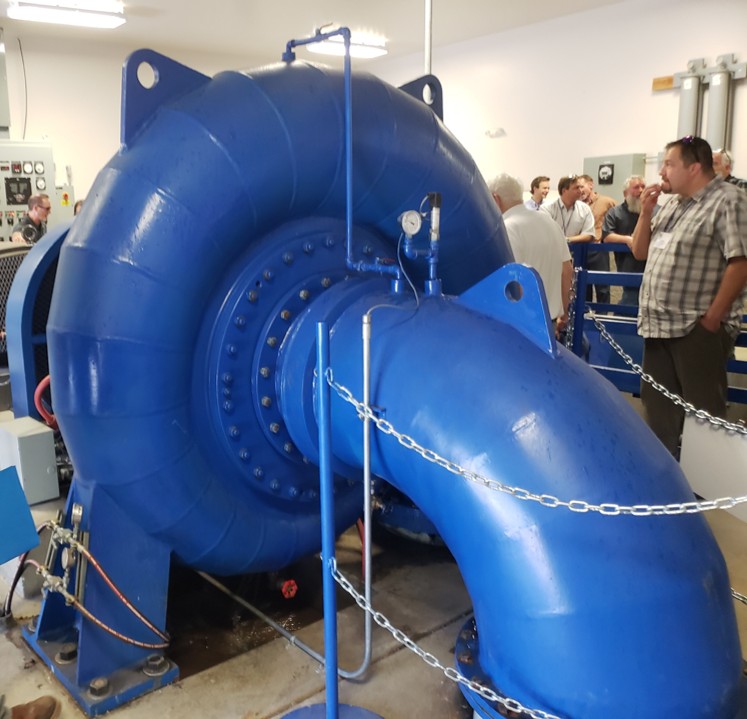
For PWS systems, ICH can be added to existing water infrastructure to harness energy within certain pressure zones, with pressure reducing valve (PRV) locations being an opportune target. Although a PRV can simply be replaced by a turbine to extract energy and thereby reduce pressure, bypass piping is more often added to convey water around a PRV and through a turbine. Such bypass loops provide redundancy to allow for maximum flow through the turbine and ease of operation during maintenance. Conceptually, excess pressure may be available due to the natural variation in elevation from a water source to a treatment plant or at certain points between a treatment plant and end users. Pressurized flows can also be tapped from wastewater, though such projects are far less common and face additional development challenges, particularly related to economic feasibility.
ICH provides several benefits: (1) predictable power generation as a result of continuous pressure and flow monitoring, (2) extended PRV service life due to reduced workload, (3) reduced barriers to entry thanks to a licensing exemption for adding power generation capability to existing infrastructure with limited to no environmental impact, and (4) low relative costs for up-front financing. PWS systems can vary widely, so ICH potential is often site-specific, though the technological solutions are well established.
While most currently operational ICH is in municipal water systems, there is great interest in exploring opportunities in the industrial sector. The CHEETA project is investigating conduit hydropower opportunities for both the municipal and industrial sectors. Research is currently planned to extend through 2027, producing a variety of products, including technical reports on challenges, costs, and opportunities, as well as a website hosting resources on best practices and a tool for estimating techno-economic feasibility for developing new in-conduit hydropower.
Are you a water utility interested in conduit hydropower?
Click here to take a 10-minute survey.
Results
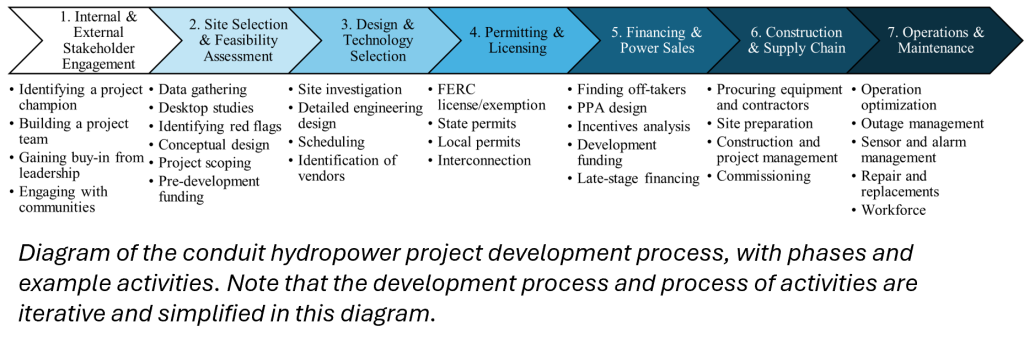
Despite the technology being relatively mature, awareness of this ICH potential is somewhat lacking. To gather information and improve awareness, ORNL hosted an April 2024 virtual workshop on conduit hydropower opportunities and challenges, for which a workshop summary report is available. The workshop results highlighted challenges that developers face during the project development process, particularly related to stakeholder engagement, financing, power sales, permitting, site selection, and feasibility assessment, among others. Furthermore, ongoing case study development for public water systems through the CHEETA project will demonstrate the technical feasibility for municipal conduit hydropower development, though efforts to date highlight challenges related to awareness and a greater need for education among relevant stakeholders.
Following the workshop, ORNL developed and published a technical report on development challenges and costs associated with ICH for public water supply systems. While the report covers both municipal and industrial applications, there are very few examples of operational industrial ICH; thus, the report focuses heavily on the municipal sector.
For municipal ICH in the United States, ORNL identified 159 operational facilities, with a combined output of 245 megawatts. These systems primarily serve the dual purpose of providing water and generating electricity. Despite the success of these existing systems, a significant opportunity remains to expand ICH capacity, with an estimated 374 megawatts of potential within municipal PWS systems that could be tapped into, based on ORNL’s national assessment completed in 2022.
In terms of cost, ICH projects exhibit considerable variability depending on factors such as the size and capacity of the system, the specific conditions of the installation site, and any additional infrastructure needed. For instance, retrofitting existing infrastructure with energy-generating components or establishing new power lines can significantly add to the capital cost of a project. The range of capital costs for ICH systems can span from relatively modest amounts for small-scale projects to millions of dollars for larger, more complex systems. The financial models currently available for predicting the costs of ICH systems have proven effective in providing general estimates; however, these models need to be updated regularly as more data become available from ongoing and newly developed projects.
Beyond cost, projects must prove financially viable, with the revenue or cost savings from operation eventually offsetting capital and operations and maintenance expenditures. Many of these small hydropower projects benefit from behind-the-meter operation in which electricity generated from the project offsets electricity use by a water treatment plant or other assets owned by the project developer.
Finally, though most of the CHEETA project is geared toward the municipal sector, ORNL is actively researching opportunities and key considerations for adding hydropower to industrial facilities and gaps highlighting needs for further research and development. ORNL has also conducted preliminary analysis of hydropower opportunity within the industrial manufacturing sector and plans to expand that research into other sectors with high energy use. Additional technical reports and products will be made available over time.
Impact
The results of CHEETA will benefit the hydropower industry by providing insights into costs, barriers, and other considerations that impact project development. Utility and industrial owners and operators and other conduit hydropower stakeholders will use the output to inform development decisions and advance affordable hydropower growth in the U.S.
In-conduit hydropower is a promising avenue for improving the reliability of water supply systems while also providing a valuable source of renewable energy. With continued innovation and supportive policy frameworks, ICH could play a crucial role in the transition to next generation energy solutions for water systems.
Next Steps
ORNL is currently executing the CHEETA project through 2027 to advance conduit hydropower through targeted research and development. Key research tasks planned include engaging stakeholders (through one-on-one meetings with select stakeholders, annual webinars, and industry conferences), summarizing best practices, assessing industrial ICH opportunities, and building a framework for conducting techno-economic feasibility with an associated tool.
Get Involved
We are actively seeking insights from relevant stakeholders, which could include you! Please reach out to us or refer interested parties by emailing [email protected] or [email protected]. We would love to share information and hear about your perspective and experiences. We will be hosting online webinars in the coming months, please email us to get the latest information. Stay tuned for more updates.
Researchers


Contact