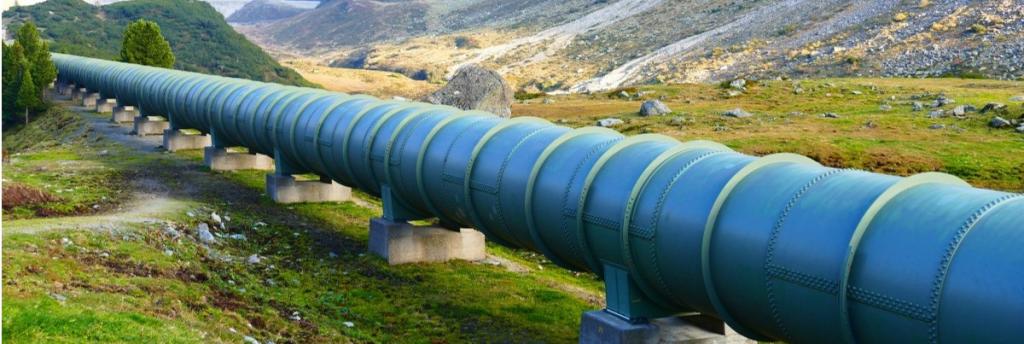
A step-by-step guide for municipalities exploring how to harness electricity from existing water infrastructure, turning pressure that’s currently wasted into power that serves communities.
What is Municipal Conduit Hydropower?
Public water systems (PWSs) service water for municipal and industrial purposes, as water is collected, treated, supplied, used, and discharged. These systems transport water from a river, reservoir or well field to a water treatment plant for public, commercial, or industrial consumption. After the water is used, it is transported to a wastewater treatment facility before safely discharging to a receiving water body.
Hydroelectric power (or hydropower) can be added to PWSs to recover energy from the flowing water, with ideal solutions located where extra pressure exists. Such application of energy technology is referred to as “conduit hydropower.” Because these projects leverage existing infrastructure and impart minimal environmental impact, conduit hydropower projects are subject to a simplified, 45‑day federal regulatory approval process — much shorter than other forms of hydropower.

How it Works
In‑conduit hydropower (ICH) can be used for municipal and industrial applications and in both water supply and wastewater discharge settings, though the majority of current operating projects are for municipal water supply.
It works like most hydropower. As water moves through a pipe or other conveyance, the water pressure and flow rate change. In certain locations — such as pressure reducing valve (PRV) installations — excess pressure and sufficient flow are present and can be used to convert the hydropotential energy into electricity by spinning a turbine‑generator unit. This electricity can be sold to the grid or used locally in a behind‑the‑meter arrangement. The water then continues to the customer at a lower, but adequate, pressure.
Benefits of In-Conduit Hydropower

Recover Energy
Generate electricity from water already flowing through the system: no new dams, no diverted streams.

Streamlined Approval
Qualifying conduit projects benefit from a 45‑day federal regulatory pathway.

Minimal Impact
Existing infrastructure means low environmental footprint and limited new construction.
This guide walks through the ICH development process as a series of distinct and interrelated phases, from early stakeholder engagement through long-term operations and maintenance. These include:
- Stakeholder Engagement
- Site Selection & Feasibility
- Design & Technology
- Permitting & Licensing
- Financing & Power Sales
- Construction & Supply Chain
- Operations & Maintenance
This guide is intended as a general overview of the steps, considerations, and best practices a municipality is likely to encounter, rather than a comprehensive technical manual. The development process is outlined below, and additional information and resources, including links to guides, tools, and references — from national laboratories, federal agencies, and industry — are accessible through the provided links.
Development Process
Phase 1
Stakeholder Engagement
Identify a Hydropower Champion and engage the community early to build trust and align goals.

Internal Engagement
Identifying a Hydropower Champion within the organization is key to driving progress. Hydropower Champions are individuals or teams responsible for managing water infrastructure and advancing modernization projects through advocacy and decision-making. By building internal support, coordinating across departments, and keeping leadership informed, they help align organizational goals with project needs. Their leadership ensures hydropower opportunities are prioritized, resources are mobilized, and the project moves forward effectively.
External Engagement
Working with the community is a key part of hydropower projects. It helps developers understand what local people need, what concerns them, and what they expect. By listening and involving the community early on, developers can build trust, avoid unnecessary conflicts, and find solutions to potential problems before they grow. This makes the project run more smoothly for everyone involved.
Why Engage?
- Building Trust: Open communication builds credibility and shows stakeholders their voices matter.
- Spotting Issues Early: Early engagement uncovers concerns before they become bigger problems.
- Reducing Conflicts: Listening and responding to diverse views helps prevent disputes.
- Better Outcomes: Involving stakeholders leads to stronger, more sustainable projects.
- Staying Compliant: Early dialogue ensures alignment with rules and standards.
- Gaining Support: When people feel heard, they’re more likely to support the project.
How to Engage?
- Engage Early: Identify all groups and individuals who may be affected or interested and develop an engagement plan.
- Be Transparent: Share clear, accurate, and accessible information about the project and its impacts.
- Invite Feedback: Provide simple ways for stakeholders to share input throughout the project.
- Respond Quickly: Address concerns promptly with timely and meaningful action.
Who to Engage?
- Interconnecting Utility
- Customers, Local Citizens and Businesses
- Community Energy Organizations
- Environmental Regulatory Agencies
- Neighboring Landowners
- Non-Governmental Organizations
Resources
Hydropower Production within Water Supply and Treatment Systems: A pocket guide with high level information on conduit hydropower within water supply systems.
Read the guide: PNNL Guide ↗
Local Renewable Energy Benefits and Resources: An overview of renewable energy benefits from the EPA.
Read the overview: EPA Resource ↗
Quantifying the Multiple Benefits of Energy Efficiency and Renewable Energy: A guide with methods, tools, and steps to quantify renewable energy benefits for state and local governments.
Read the guide: EPA Guide ↗
Phase 2
Site Selection and Feasibility
Evaluate pressure, flow, and space at PRV sites to identify and rank the best candidates.

Identify Potential Sites
Conduit hydropower opportunities emerge wherever excess water pressure exists in a distribution system. Public water utilities collect, treat, and deliver water using gravity or pumps, often creating more pressure than is required. To manage this, pressure-reducing valves (PRVs) are installed to lower excess pressure. By installing a turbine in parallel with a PRV, the otherwise wasted energy can be converted into electricity. The PRV continues to function as a safeguard, ensuring safe and reliable pressure control regardless of turbine operation.
Gather General Data
To evaluate site suitability and prioritize locations for conduit hydropower, collect baseline information on pressure, flow, space, interconnection options, and local energy demand.
Pressure: Measure the drop in pressure across the PRV (upstream vs. downstream). At least 8 psi is generally needed.
Flow: Record flow rate and variability. Steady, consistent flow supports longer turbine operation and reduces equipment costs. Highly variable or intermittent flow may require more advanced turbines or justify generating only from the “base flow,” with excess bypassing through the PRV.
Available Space: Confirm whether adequate space exists in existing infrastructure—such as an underground vault or treatment facility—to minimize construction costs and site impacts.
Interconnection Proximity: Identify access to three-phase power. Interconnection costs rise substantially with distance from the grid.
Local Power Demand: Look for nearby loads that could directly use the generated electricity. Net metering can further increase value compared to selling power wholesale to the utility.
Case Study: San Gabriel Valley Water Company (Sandhill)
Three potential sites were identified, and the Sandhill site was selected based on its high pressure drop and consistent flow. Read the full case study.
Preliminary Evaluation
Comparing the data collected from all potential sites helps identify which locations are unsuitable and which have the greatest potential. Potential capacity can be roughly estimated by multiplying the pressure (psi) by the flow (gpm) and then by 12. Several turbine suppliers also offer web-based tools to help estimate capacity.
Approximate capacity formula: psi x gpm x 12
Minimum pressure: 8 psi
Feasibility Assessment Tools
Several tools are available to help evaluate technical and economic feasibility before committing to a full engineering study. The ORNL Conduit Hydropower Feasibility Tool is recommended as a starting point because it is purpose-built for municipal conduit projects, technology-neutral, and free to use. Supplier-specific tools can also be useful, particularly when a project is narrowing in on a specific technology.
ORNL Conduit Hydropower Feasibility Tool
Developed by Oak Ridge National Laboratory under the Department of Energy’s Conduit Hydropower Engineering, Evaluation, and Technology Acceleration (CHEETA) project, this tool helps users estimate whether a conduit hydropower project is technically and financially feasible. Users upload daily or hourly flow measurements, answer a few questions, and the tool returns:
- Annual energy production (MWh/year)
- Recommended turbine type and specific model selection
- Capital cost estimate based on the ORNL Baseline Cost Model 2025
- Financial metrics — benefit/cost ratio, internal rate of return, and simple payback
The tool walks through a seven-step workflow covering data upload, design point selection, turbine selection, energy results, economics inputs, and financial results. An optional AI assistant is available to answer questions at each step.
Supplier-Specific Tools
Several turbine suppliers offer free web-based estimators. These are useful for comparing to ORNL tool results or for getting a quick first-pass estimate, but results will generally reflect the supplier’s own technology.
InPipe Energy Free Assessment: Web-based tool for quick evaluation of in-conduit hydropower potential. Users provide site info, and InPipe estimates energy generation and feasibility.
Visit the tool:InPipe ↗
nLine Energy Hydro Assessment: Web-based tool for evaluating in-conduit hydropower potential. Users input site parameters to get preliminary estimates of energy production, costs, and system feasibility.
Visit the tool: nLine ↗
Rentricity Site Assessment: Free web-based assessment for in-conduit hydropower using site flow and pressure data. Provides preliminary energy generation estimates and equipment recommendations.
See the assessment: Rentricity ↗
Soar Hydropower Calculator: Allows input of pressure, flow, and head to quickly estimate power output. Best for basic site estimations.
See the calculator: Soar ↗
Feasibility Assessment
After preliminary screening identifies promising sites, a full feasibility study should be conducted to evaluate both technical and economic viability. At this stage, engaging outside engineering expertise can be valuable. A standard feasibility assessment typically includes:
- Site Parameters:Define design flow, head, generating capacity, and estimated annual energy production.
- Layout and Design:Plan structures and improvements needed for the turbine, generator, and control systems.
- Permitting:Identify all required local, state, and federal permits.
- Cost Estimate:Develop a preliminary estimate of installation and construction costs.
- Revenue and Power Sales:Determine and compare power sales mechanisms (e.g., net metering, PPA) and project annual revenue.
- Economic Evaluation:Compare projected costs with expected revenue to assess project viability.
- Risk Assessment: Identify potential critical flaws, such as planned system upgrades that could alter operating conditions.
Resources
ORNL Conduit Hydropower Feasibility Tool: Free, technology-neutral feasibility tool developed under the DOE CHEETA project. Estimates energy production, recommends turbine type/model, and produces capital cost and financial estimates.
View the tool: ORNL CHEETA ↗
National Hydropower Association (NHA) Membership Directory: Includes engineering and consulting companies with experience in hydropower.
See the directory: NHA Directory ↗
FERC Qualifying Conduit Definition: Municipal Conduit Hydropower is generally considered a “Qualifying Conduit Hydropower Project”. This site helps verify eligibility.
Visit the site: FERC ↗
MassDEP Hydropower Project Screening Tool: A screening tool for in-conduit hydropower technologies with a focus on water infrastructure opportunities.
View the tool: MassDEP ↗
CEC In-Conduit Hydropower Business Case Assessment Tool: Allows operators to evaluate technical and economic feasibility, assess hydropower potential, recommend technologies, and estimate life-cycle costs.
View the tool: CEC Tool ↗
ORNL Baseline Cost Model: Provides preliminary estimates of conduit hydropower costs based on head and capacity.
See the model: ORNL ↗
Database of State Incentives for Renewables & Efficiency (DSIRE): Database containing information on incentives available for renewable energy projects, including conduit hydropower.
Visit the database: DSIRE ↗
Phase 3
Design and Technology
Gather detailed data, select a turbine, finalize layout, and complete a detailed cost estimate.

Select Design Pathway
Municipalities have several options for finalizing project design. They may rely on in-house engineering staff, contract with consulting engineers, or work directly with a turbine supplier that provides design services. The pathway chosen will depend on available expertise, budget, and project complexity.
Gather Detailed Data
Preliminary estimates from Phase 2 relied on limited information. For final design, more comprehensive data are needed. Accurately characterizing variability in head and flow, along with projecting future water demands, ensures proper turbine selection and optimal electricity generation.
Pressure & Flow Data
- Collect pressure readings upstream and downstream of the PRV, along with flow through the PRV.
- Stable conditions may require daily readings; fluctuating systems may need 15-minute intervals.
- A full year of data is recommended to capture seasonal changes.
- Note any planned system expansion or operational adjustments.
Utility Bills
- If on-site use or net metering is planned, obtain monthly utility bills showing demand (kW) and energy use (kWh).
- Bills indicate the tariff structure—whether based on usage (¢/kWh) or a combination of usage and demand charges ($/kW/month).
- Demand charges can only be offset when hydropower generation coincides with peak demand.
Select a Turbine
The DOE/Idaho National Lab Hydropower Technology Catalog offers guidance on turbine types and suppliers matched to available head and flow. The most common and least expensive turbine is known as a Pump-As-Turbine (PAT) — pumps that run in reverse to generate electricity.
Fixed Speed PAT: Steady or base flow
Variable Speed PAT: Highly variable head/flow
Traditional Turbine: Complex Sites
Turbines at this scale are generally supplied as a “Water-to-Wire” package, including the turbine, generator, controls, switchgear, and inlet valve.
Auxiliary Components & Final Design
In addition to the Water-to-Wire package, auxiliary components are needed — at a minimum, these include additional valves and piping, a transformer, and electrical cable for interconnection. Additionally, surge protection, communications, and other necessary components may be required.
During final design, the exact siting and configuration of each component must be determined to ensure constructability and efficient operation. With all components identified, prepare a comprehensive cost estimate that accounts for equipment, installation, auxiliary systems, and interconnection.
Resources
National Hydropower Association (NHA) Membership Directory: Includes engineering and consulting companies with experience in hydropower.
View the directory: NHA ↗
INL Hydropower Technology Catalog: Guidance on turbine types and suppliers matched to available head and flow conditions.
View the catalog: HydroTech ↗
Phase 4
Permitting and Licensing
File a FERC Notice of Intent, obtain local permits, and secure utility interconnection approval.

Federal Licensing (FERC)
The Hydropower Regulatory Efficiency Act of 2013 removed certain “qualified” conduit hydropower projects from Federal Energy Regulatory Commission (FERC) jurisdiction. Congress recognized many conduit projects pose minimal environmental or operational impacts and should not be regulated like traditional hydropower facilities.
To be considered a “Qualifying Conduit Hydropower Facility”, a project must meet all of the following conditions:
- Existing Conduit: The project is located on an existing conduit — any tunnel, canal, pipeline, aqueduct, flume, ditch, or similar manmade water conveyance operated for the distribution of water for agricultural, municipal, or industrial consumption, and is not primarily for the generation of electricity.
- Non-Federal Ownership: The facility generates electric power using only the hydroelectric potential of a non-federally owned conduit.
- Capacity Limit: The facility has an installed capacity that does not exceed 40 megawatts (MW).
- New Authorization: The facility was not licensed or exempted from the licensing requirements of Part I of the FPA on or before August 9, 2013.
Municipal conduit hydropower projects generally meet these conditions and only need to submit a Notice of Intent (NOI) to the FERC for approval. This review process, which includes a public comment period, is completed within 45 days.
State, County, or Local Permits
The Qualifying Conduit Facility designation does not exempt the project from other state and local permit requirements. These permits vary by jurisdiction but often include building permits, electrical inspections, and approvals for construction activities. Requirements are generally similar to those for other water supply infrastructure.
The Hydropower RAPID Toolkit (developed by the U.S. Department of Energy) provides guidance on permitting pathways, though many requirements listed there will not apply to low-impact conduit projects. Always consult local agencies to confirm which permits are necessary.
Interconnection
While not a formal permit, utility approval is required to interconnect the generator with the electrical grid. An interconnection application must demonstrate compliance with the utility’s interconnection standards to ensure safe and reliable operation. The time and cost of this process depend on both the project’s capacity and the grid’s ability to absorb additional generation.
FERC NOI Review: ~45 days
Public Comment Period: Required
Max Qualifying Capacity: 40 MW
FERC eLibrary: Past NOI Examples
Examples of past Qualifying Conduit Facility NOIs can be accessed through the FERC eLibrary by entering “CD*” as the docket number in a general search.
Resources
FERC NOI Template: Word template provided by FERC for consideration as a Qualifying Conduit Facility.
Download the template: FERC Template ↗
FERC eLibrary: Enter “CD*” as the docket number in a general search to review submitted NOIs, adjust the dates to see earlier submissions.
View the library: eLibrary ↗
RAPID Toolkit: Regulatory and Permitting Information Desktop Toolkit — provides project permitting process information for developers.
Access the toolkit: RAPID ↗
Small Hydro Interconnection Best Practices Guidelines and Templates: Guidelines for small hydropower interconnection.
See the guidelines: ORNL ↗
Small Hydropower Interconnection: Decision Support Tool Users Guide: User guide for the interconnection decision support tool.
Read the guide: ORNL ↗
Phase 5
Financing and Power Sales
Identify incentives, secure financing, determine the best pathway to monetize electricity.

Federal, State & Local Incentives
Federal, State, and Local incentives are available for developing new, carbon-neutral, renewable energy projects, including conduit hydropower. Incentives generally include tax credits, grants, and low-interest loans. The Database of State Incentives for Renewables & Efficiency (DSIRE) is a valuable resource for identifying programs, including Federal programs.
Although the PTC and ITC are tax credits, there is a direct pay (elective pay) alternative available to non-taxable entities such as municipalities.
Clean Electricity Production Tax Credit (PTC): Non-competitive, based on annual kWh generation for 10 years.
Read about this incentive: IRS ↗
Clean Electricity Investment Tax Credit (ITC): Non-competitive, based on the capital cost of the project. One time awarded after commissioning.
Read about this incentive: IRS ↗
Section 242: Hydroelectric Production Incentive Program: Non-competitive, based on annual kWh generation for 10 years, depends on funding allocations.
Read about this incentive: DOE ↗
Financing Options
A municipality may take several different routes to finance a conduit hydropower project. The choice depends on project scale, local financial capacity, and the availability of incentives.
Municipal Bonds
- Tax-exempt bonds can be combined with federal incentives such as the ITC or PTC.
- IRS direct payment can be applied to retire a portion of bond principal, reducing long-term debt service.
State Revolving Funds
- Available for water and wastewater infrastructure projects that incorporate hydropower.
- Very low interest rates and, in some cases, partial loan forgiveness.
Public-Private Partnerships
- A private entity may finance, build, and operate the facility while the municipality provides infrastructure access or long-term offtake agreements.
- Municipalities benefit from renewable generation without carrying the full financing burden.
Power Sales Pathways
Net Metering: One of the most common pathways for smaller municipal systems. Electricity generated is credited against the municipality’s own electric load at retail rates. Excess generation may be credited forward or paid at an avoided-cost rate, depending on state policy. This approach guarantees full value for on-site consumption, reduces operating budgets, and minimizes exposure to wholesale market price volatility.
Standard Tariff/Feed-In Program: Some states and utilities offer published tariffs for qualifying renewable generation, including small hydro. In these arrangements, the municipality sells all or part of its output directly to the local utility at a fixed rate per kilowatt-hour. While often lower than retail net metering credits, these tariffs provide predictable revenue streams and are easier to model for financing purposes.
Power Purchase Agreements (PPAs): Larger projects may enter into PPAs with utilities or other large customers. A PPA is a contract that specifies the quantity, price, and duration for electricity sales. For municipalities, a PPA can be signed with the serving utility, a neighboring cooperative, or even a corporate off-taker interested in renewable energy. PPAs offer long-term price certainty and can be tailored to match project financing needs.
Economic Evaluation
Once incentives have been identified, financing structures considered, and power sales pathways evaluated, the project’s economic viability can be assessed. A typical evaluation combines projected revenue (electricity sales or avoided costs, plus any applicable incentives or credits) with estimated capital and ongoing O&M costs to calculate key financial metrics — including simple payback period, internal rate of return (IRR), benefit/cost ratio, and net present value. These metrics help compare the project against other potential investments and inform financing decisions. Tools such as the ORNL Conduit Hydropower Feasibility Tool can streamline this analysis by automating the cash flow calculations once site-specific inputs are provided.
Resources
ORNL Conduit Hydropower Feasibility Tool: Free, technology-neutral feasibility tool that estimates energy production, capital costs, and financial metrics including IRR, payback, and benefit/cost ratio.
Use the tool: ORNL CHEETA ↗
DSIRE Website: Database of State Incentives for Renewables & Efficiency, includes federal incentives and net metering policies.
View the database: DSIRE ↗
Energy Recovery Hydropower: Prospects for Off-Setting Electricity Costs: Includes examples of state incentives and several case studies.
View the resource: NREL ↗
EPA’s Clean Energy Financing Toolkit for Decisionmakers: Summary of financing options including municipal bonds and revolving loan funds.
See the toolkit: EPA ↗
California Energy Commission — In-Conduit Hydropower Business Case Assessment Tool: Tool to estimate energy generation potential and evaluate economic viability.
Use the tool: CEC ↗
Alden Labs — In-Conduit Hydropower Screening Tool: Tool to estimate power generation potential and perform a preliminary cost/benefit analysis.
Use the tool: Alden Labs ↗
Phase 6
Construction and Supply Chain
Choose a contracting pathway, procure long-lead equipment early, and manage construction.

Construction and Contracting Options
Once a conduit hydropower project has reached final design, the municipality must determine how to carry out construction and contracting. The approach will depend on the project’s scale, complexity, internal capacity, and the municipality’s procurement rules.
Self-Performance: Municipal staff manage and execute most of the work. Most practical for utilities or public works departments with in-house crews experienced in pipework, electrical connections, or small-scale civil construction. Can reduce costs and increase control over the schedule, but may stretch staff capacity and require supplemental training or specialized subcontractors for turbine installation.
Design-Bid-Build: A common approach where the municipality completes the design and then solicits competitive bids from contractors. Familiar to many public entities, ensures transparency, and often results in competitive pricing. However, the separation between design and construction can lead to change orders if site conditions differ from what was anticipated.
Design-Build: A single firm is responsible for both final design and construction. Can shorten the project timeline, reduce the risk of disputes between designer and builder, and provide a single point of accountability. Typically requires a more sophisticated procurement process and a strong municipal project manager to evaluate proposals and oversee performance.
Public-Private Partnerships: A private partner may finance, build, and operate the hydropower facility in exchange for a share of revenues or a long-term power purchase agreement. While this reduces upfront costs and shifts risk away from the municipality, it also limits direct control over the project and future revenue streams.
Identifying Qualified Contractors
Contractors experienced in water treatment plants, pump stations, and distribution systems typically possess the necessary skills for conduit hydropower projects. While they may lack direct hydropower experience, most civil, piping, and electrical trades are transferable.
- Focus on firms with a strong track record in water infrastructure and capacity to handle specialized tasks such as turbine installation, system integration, and utility interconnections.
- If direct hydropower experience is limited, contractors can partner with turbine suppliers or electrical specialists.
- Municipal procurement processes can include prequalification by requesting qualifications, references, and proof of bonding and insurance.
- Local or regional firms may also bring valuable knowledge of permitting and site conditions.
- Strong communication and coordination are essential — selecting a contractor that is collaborative and responsive will help keep construction on schedule.
Several companies focus specifically on offering conduit hydropower services to municipalities, providing initial site screening, feasibility assessments, design, procurement, and construction under one roof. Examples include Rentricity, InPipe Energy, and nLine Energy. This is not an exhaustive list and is not a recommendation.
Supply Chain Considerations
Conduit hydropower projects draw on both standard waterworks materials and specialized equipment. While piping, valves, and electrical gear are readily available, transformers, turbines, generators, and controls often have lead times of up to a year.
To avoid delays, municipalities should coordinate early with suppliers and may even procure major equipment directly, ensuring it is on hand when construction begins.
Case Study: Manitou Springs
Design-Build example with early equipment procurement — demonstrating how advance planning for long-lead items kept the project on schedule.
Example RFPs
Reviewing RFPs from other municipal conduit hydropower projects can help shape procurement scope, evaluation criteria, and risk allocation. Below is a featured example, with additional examples to follow as they become available.
City of Aurora, CO — Potomac PRV Hydroelectric Energy Recovery (R‑6127A)
A turn-key Energy Recovery Valve (ERV) system at Aurora Water’s Gun Club PRV station. Released April 2026 as a federally-funded project subject to Davis-Bacon, Buy America/Build America, and SAM.gov registration requirements. The procurement is structured as a multi-phase process, with selection based on Phase 1 proposals (with optional follow-on phases for short-list interviews and site walkthroughs).
Useful as a template for: turn-key procurement scope, federally-funded project requirements, multi-phase evaluation structure, and a fixed-schedule timeline from issuance through contractor selection.
Additional example RFPs will be added as they are identified. Many municipal hydropower RFPs are posted only on procurement portals (e.g., BidNet, DemandStar) during the open solicitation window and are not always archived publicly. Municipalities planning a conduit project may request copies directly from peer utilities or through the National Hydropower Association.
Phase 7
Operations and Maintenance
Automate monitoring, maintain turbine components, and balance in-house and contracted support.

Conduit hydropower projects are generally straightforward to operate and maintain compared to larger hydro facilities. Because they are integrated into existing water infrastructure, day-to-day operation is often automated, with turbines and controls designed to run with minimal intervention.
Routine monitoring of pressures, flows, and generation output can typically be handled by existing water system staff using SCADA systems or simple metering.
Maintenance Requirements
Maintenance requirements are modest. Standard tasks include:
- Periodic inspection of valves and seals
- Lubrication of bearings
- Checks on electrical and control systems
Turbine suppliers often provide maintenance schedules and training, and in many cases, replacement parts are limited to items already familiar to water utility mechanics and electricians.
Typical Annual O&M (% of capital cost): 1 – 6 %
In House: Much routine work can be done on-site
Staffing Considerations
A key step for municipalities is identifying which tasks can be handled in-house and where outside support is needed.
In-House Tasks
- Routine monitoring via SCADA
- Pressure and flow checks
- Valve and seal inspections
- Basic electrical checks
- Staff experienced with pumps, motors, and waterworks controls can handle most routine O&M.
Outside Support
- Specialized turbine maintenance
- Complex electrical troubleshooting
- Municipalities may rely on equipment suppliers, local electrical contractors, or annual service agreements.
Clarifying these roles early ensures that the project remains reliable without overburdening staff.
Contact the CHEETA Project Team
Scott DeNeale, principal investigator for the CHEETA Project
Antonia Chu (ORNL)
Lora Davis (ORNL)
Lindsay Ashworth (Small Hydro Consulting)