Researchers Sang-Ho Kim, An-Ping Li, Bronson Messer and Zac Ward of ORNL have been named Fellows of the American Physical Society in recognition of their outstanding impact in their respective fields.
The Department of Energy has renewed funding for the Quantum Science Center through 2030 to create a new scientific ecosystem for fault-tolerant, quantum-accelerated high-performance computing.
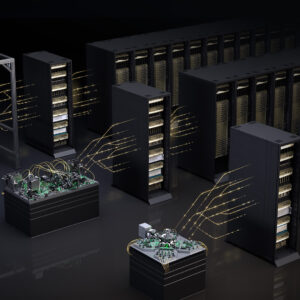
ORNL, NVIDIA, and HPE are partnering to integrate quantum computing, AI, and high-performance computing using NVIDIA NVQLink and CUDA-Q, establishing a hybrid testbed at ORNL to advance quantum–classical convergence and scientific discovery.
The U.S. Department of Energy announced today its newest supercomputers, Discovery and Lux, at Oak Ridge National Laboratory that will expand America’s leadership in artificial intelligence for scientific computing, strengthen national security, and drive the next generation of Gold Standard Science and innovation.
By combining AI with molecular dynamics simulations, researchers at ORNL have developed a new tool to more accurately predict how plants and helpful microbes communicate and form partnerships at the most fundamental level. The new AI-powered workflow helps scientists identify which plant genes control the best microbial partnerships.
Analyzing massive datasets from nuclear physics experiments can take hours or days to process, but researchers are working to radically reduce that time to mere seconds using special software being developed at the Department of Energy’s Lawrence Berkeley and Oak Ridge national laboratories.
FREDA is a new tool being developed at ORNL that will accelerate the design and testing of next-generation fusion devices. It is the first tool of its kind to combine plasma and engineering modeling capabilities and utilize high performance computing resources.
Two-and-a-half years after breaking the exascale barrier, the Frontier supercomputer at the Department of Energy’s Oak Ridge National Laboratory continues to set new standards for its computing speed and performance.
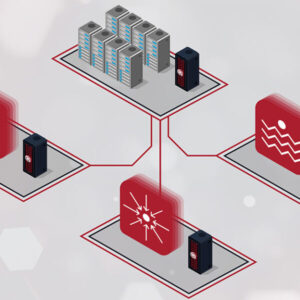
To bridge the gap between experimental facilities and supercomputers, experts from SLAC National Accelerator Laboratory are teaming up with other DOE national laboratories to build a new data streaming pipeline. The pipeline will allow researchers to send their data to the nation’s leading computing centers for analysis in real time even as their experiments are taking place.