Concentrated transition metal alloys with the formula NiCoCrx, with x≈1, and a simple cubic crystal structure, display transport, magnetic and thermodynamic signatures exhibited by more structurally complex compounds near a quantum critical point (QCP). These alloys provide ideal systems to stu...
Multiferroic materials are important because their electrical and magnetic properties are coupled. Because BiFeO3 magnetically orders below 640 K, it is one of two known room-temperature multiferroic materials. Recently, theorists at Oak Ridge National Laboratory discovered that the...
Theoretical calculations, based on newly obtained experimental geometries in strained BiFeO3 thin films, predict an almost barrierless transition between co-existing phases. This facile transition provides insight into the origin of the high electromechanical responses found in coexisting phases...
Researchers devised a model that can predict which combinations of 5 or more elements will form new “high-entropy alloys.” This work, which utilizes values obtained from data mining of high-throughput calculations of binary compounds, requires no experimental or empirically derived input and advan...
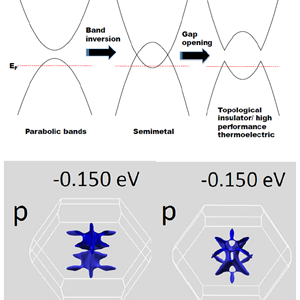
Quantum mechanical calculations of electronic structure and transport for Bi2Te3 and its sister material Bi2Te2Se solved the long-standing puzzle of why many materials that are topological insulators are also excellent thermoelectrics. Topological insulators are a newly found class of materials wh...
A synergistic combination of atomic-scale experiment and theory identify Ni antisites as the predominant defects in a lithium–manganese-rich cathode material. In addition, their formation energies are facet-dependent, with larger defect concentrations observed at open (010) facets. High-voltage ...
Density functional theory (DFT) calculations show that among the four types of (001) SrTiO3 | (001) MgO interface structures, the TiO2-terminated SrTiO3 containing electrostatically attractive Mg–O and Ti–O ion–ion interactions form the most stable
Neutron and x-ray experiments, coupled with large-scale first-principles calculations have revealed the origin of the metal–insulator transition in vanadium dioxide, an intractable question in phase stability for more than 50 years. When heated to just above room temperature, the material undergoe...
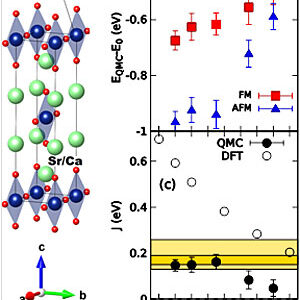
Magnetic couplings in a realistic cuprate system have been correctly predicted for the first time with highly accurate Quantum Monte Carlo (QMC) calculations. Effective magnetic models of superconductivity (previously reliant on experiment) can now be derived with confidence from theory, which co...
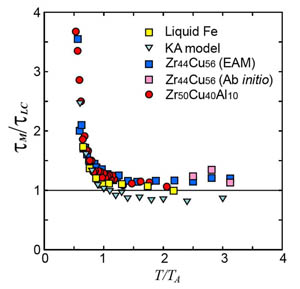
Elementary excitations in metallic liquids were discovered through computer simulation, representing a major advance in the physics of liquids. In solids the elementary excitations of lattice dynamics are phonons, but in liquids they have a very short lifetime. The current work shows that the ele...