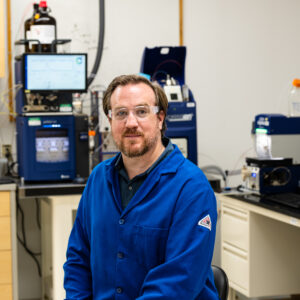
ORNL researchers are exploring how engineered bacterial spores could capture rare earth elements from acid mine drainage and other waste streams. The SpoREE project combines biology, AI and advanced analysis to develop reusable materials for recovering critical minerals.
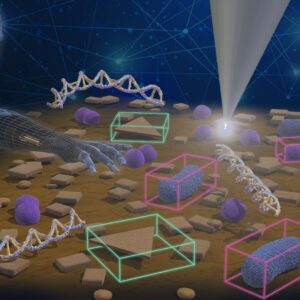
ORNL researchers developed SimuScan, an AI framework that uses realistic synthetic data to identify nanoscale features in atomic force microscope images. It can guide microscopes toward the most informative areas of a sample for closer study.
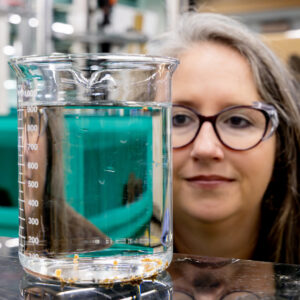
ORNL researchers developed two domestically sourced materials for Smith-Root’s environmental DNA samplers that are cheaper and meet or exceed performance requirements. The materials could improve filtration while reducing reliance on international suppliers.
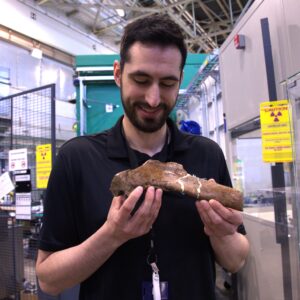
A broken rib from Scotty, the largest Tyrannosaurus rex skeleton discovered, is helping scientists uncover new information about life on Earth 66 million years ago. Using neutron imaging at ORNL, the scientists peered inside the fossilized bone to build 3D views without altering the preserved soft tissue.
Click here for static version. What if one answer to the supply crisis isn’t buried in a mine shaft, but growing quietly in a field? For too long, the United States has relied on foreign sources for most of the raw materials powering its technological future, the essential minerals in every smartphone, battery pack and
ORNL earned a new lab record with 22 R&D 100 Awards in 2026 for technologies that advance energy, manufacturing, computing, biotechnology and other fields. ORNL led 18 of the winning technologies and contributed to four additional award-winning projects led by partner institutions.
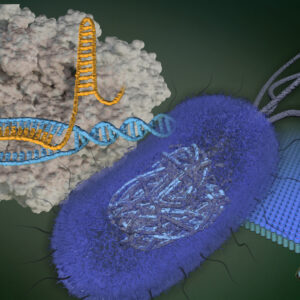
ORNL researchers evaluated nearly 500,000 CRISPR-Cas9 guide RNAs in E. coli and found that more than 93 percent work as intended. Their free gRNA Atlas helps scientists select reliable guides and engineer microbes more efficiently for producing chemicals, materials and medicines.
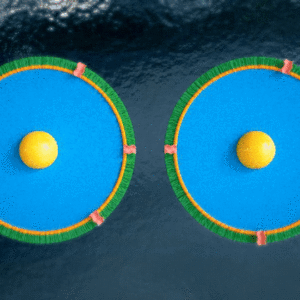
ORNL researchers found that lipid bilayers, the basic structure of cell membranes, can exhibit electrical behaviors associated with learning and memory. The discovery could advance brain-inspired computing technologies and provide new insights into neurological disorders.
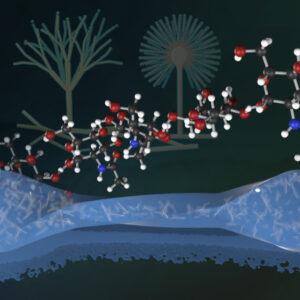
Researchers at ORNL and the University of Tennessee, Knoxville, have made a scientific advance by using a natural substance from fungi, called chitin, to create hydrogels that are both significantly stronger and tougher. This new material could lead to safer medical devices, longer-lasting coatings and other innovations that improve everyday technology and health care.
Oak Ridge National Laboratory researchers developed a high-throughput microbial QTL mapping platform that combines synthetic biology, AI, automation and gene editing to identify the genetic basis of complex bacterial traits up to 10 times faster than previous methods. The platform enables more precise engineering of microbes for applications including specialty chemicals manufacturing, bioenergy and critical minerals recovery, and is available for licensing.
Mengjun Shu, a scientist at Oak Ridge National Laboratory, uses big data, statistical modeling and artificial intelligence to study how trees respond to environmental stress and identify traits that can improve biomass crops such as poplar. Her research combines genetics, plant imaging and microbial studies to advance biotechnology for U.S. manufacturing and agriculture while helping scientists better understand tree resilience.
The Department of Energy’s Oak Ridge National Laboratory scientists will lead nine and contribute to an additional 30 projects of the Genesis Mission, which aims to transform science in the U.S.