ORNL’s High Flux Isotope Reactor offers flexible testing, advanced instrumentation and on-site facilities to accelerate nuclear fuel development. Its capabilities provide critical data needed to qualify new fuels and support advanced reactor deployment.
Kairos Power announced the Nuclear Center for Advanced Manufacturing and Precast, an initiative focused on maturing new manufacturing and construction methods and developing vocational training for skilled workers in East Tennessee to support the deployment of advanced nuclear reactors.
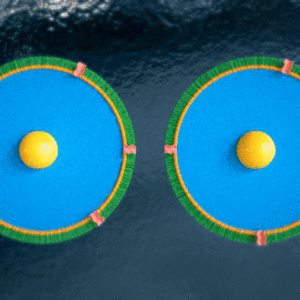
ORNL researchers found that lipid bilayers, the basic structure of cell membranes, can exhibit electrical behaviors associated with learning and memory. The discovery could advance brain-inspired computing technologies and provide new insights into neurological disorders.
Oak Ridge National Laboratory has resumed production of W-188/Re-188 generators, which provide the radioactive isotope Re-188 for medical research. Vanderbilt researchers used an updated ORNL generator to test a Re-188-based treatment for prostate cancer in mice, with preliminary results described as promising.
ORNL has developed a new californium-252 processing method that reduces separation time by about a week while maintaining the same quality. As the only producer of californium-252 in the western world, ORNL is also increasing production to meet growing demand for the isotope.
Using neutrons at ORNL, researchers from The Ohio State University are studying residual stress caused by friction stir welding to reveal how to strengthen armor steel welds, like those used in military vehicles. The team’s results will help fine-tune welding parameters to create a roadmap for engineering better armor systems. They brought their research to ORNL’s HFIR due to the facility’s neutron production capabilities.
Researchers from ORNL and international collaborators discovered a simpler, lower-pressure method to produce R8 silicon, a rare form of silicon with promising applications in energy storage and electronics. By compressing amorphous (glassy) silicon instead of crystalline silicon, the team created R8 more efficiently, with neutron scattering, X-ray diffraction, and computer modeling confirming the process and suggesting it could also work for other materials like germanium.
Scientist Jason Newby measures phenomena that have never been observed, including a neutrino bouncing off an atomic nucleus — a signal as subtle as the tiny recoil of a bowling ball struck by a ping-pong ball. Capturing that effect is the kind of precision physics at the heart of a world-class research program Newby helped build at ORNL.
ORNL had a major presence at the 2026 AI+ Expo for National Competitiveness with multiple ORNL researchers presenting and demoing their latest work. Hosted by the Special Competitive Studies Project, the event brought together leaders from technology, academia, industry and government to discuss the rapidly evolving role of artificial intelligence in advancing U.S. innovation, energy resilience, competitiveness and national security.
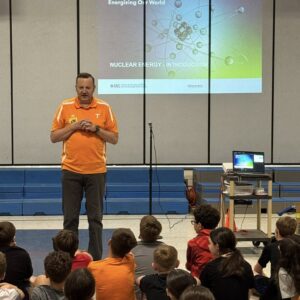
ORNL scientists partnered with Kingston Elementary School to host a Nuclear Day, introducing fifth-grade students to nuclear science through hands-on activities and interactive demonstrations. The event engaged students in topics such as radiation, uranium enrichment, nuclear reactors and chain reactions, inspiring curiosity about STEM careers and highlighting the role of nuclear science in everyday life.
Igor Remec of ORNL was named a Fellow of the American Nuclear Society, the organization’s highest honor, for his decades of contributions to nuclear safety, neutron science, and the development of ORNL’s Second Target Station.
A small team at Oak Ridge National Laboratory keeps the Spallation Neutron Source running around the clock, ensuring a powerful accelerator produces neutrons for cutting-edge research. Their work supports scientists worldwide studying materials, energy, and advanced technologies.