ORNL had a major presence at the 2026 AI+ Expo for National Competitiveness with multiple ORNL researchers presenting and demoing their latest work. Hosted by the Special Competitive Studies Project, the event brought together leaders from technology, academia, industry and government to discuss the rapidly evolving role of artificial intelligence in advancing U.S. innovation, energy resilience, competitiveness and national security.
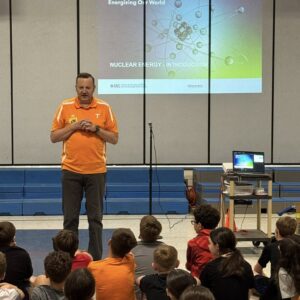
ORNL scientists partnered with Kingston Elementary School to host a Nuclear Day, introducing fifth-grade students to nuclear science through hands-on activities and interactive demonstrations. The event engaged students in topics such as radiation, uranium enrichment, nuclear reactors and chain reactions, inspiring curiosity about STEM careers and highlighting the role of nuclear science in everyday life.
Igor Remec of ORNL was named a Fellow of the American Nuclear Society, the organization’s highest honor, for his decades of contributions to nuclear safety, neutron science, and the development of ORNL’s Second Target Station.
A small team at Oak Ridge National Laboratory keeps the Spallation Neutron Source running around the clock, ensuring a powerful accelerator produces neutrons for cutting-edge research. Their work supports scientists worldwide studying materials, energy, and advanced technologies.
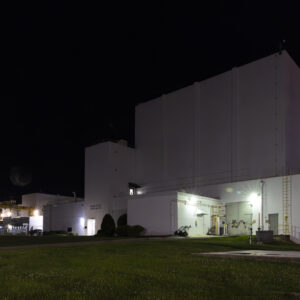
ORNL’s High Flux Isotope Reactor runs around the clock, supporting global research and isotope production. The article highlights the small, dedicated teams, especially on night shifts, who keep operations safe and running smoothly. Despite the demands, the work is rewarding because of HFIR’s impact on science and technology.
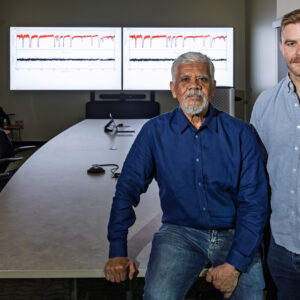
ORNL researchers combined the SAMMY code with VENUS neutron imaging to identify nuclear materials without damaging them. The method uses precise data and modeling to distinguish complex isotopes. Tests on gold, tantalum and hafnium showed it can accurately match nuclear “fingerprints.”
Performing neutron experiments at the Spallation Neutron Source delivers even better data in less time, now that the SNS linear accelerator, or linac, is well along the path to 2.8 megawatts – double its original proton power level. The additional power is thanks to the Proton Power Upgrade project, which has paved the way for constructing the planned Second Target Station, and is already helping accelerate the pace of scientific discovery across a wide range of materials and technologies at the First Target Station.
Click here to read the static version. On a clear April day in 2006, a team of engineers and scientists erupted with excitement from the control room of the Spallation Neutron Source (SNS), a newly built user facility at Oak Ridge National Laboratory. A pulse of protons — racing at nearly the speed of light — shot
ORNL’s VENUS neutron imaging instrument has begun user operations, delivering its first results at the Spallation Neutron Source. Early tests showed faster, more precise 3D imaging, advancing materials research and neutron science.
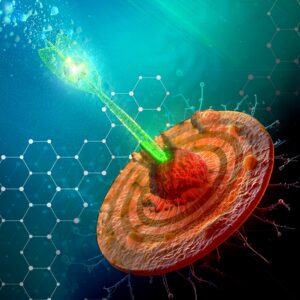
ORNL and University of Tennessee partners launched DART to develop targeted radiopharmaceutical therapies for ovarian cancer. The effort focuses on using alpha radiation to precisely destroy cancer cells while sparing healthy tissue. It also aims to grow Tennessee’s radiopharmaceutical research and workforce.
Researchers at ORNL confirmed altermagnetism in hematite using neutron scattering, identifying a common, stable mineral as a promising, low-cost material for energy-efficient spintronic technologies.
Ross E. Blevins, a 98-year-old veteran and nuclear researcher, contributed to early nuclear science at Oak Ridge National Laboratory and later helped develop TVA’s first nuclear power plants. In 2026, he returned to ORNL to reflect on his remarkable career and experiences.