Hilda Klasky, a research scientist in ORNL’s Computing and Computational Sciences Directorate, has been named a fellow of the American Medical Informatics Association.
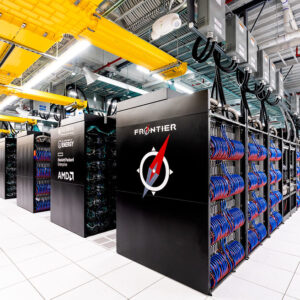
ORNL is home to the world's fastest exascale supercomputer, Frontier, which was built in part to facilitate energy-efficient and scalable AI-based algorithms and simulations.
ORNL has joined a global consortium of scientists from federal laboratories, research institutes, academia and industry to address the challenges of building large-scale artificial intelligence systems and advancing trustworthy and reliable AI for
A multidisciplinary team of researchers from Oak Ridge National Laboratory (ORNL) pioneered the use of the LLVM-based high-productivity/high-performance Julia language unifying capabilities to write an end-to-end workflow on Frontier, the first US Department of Energy (DOE) exascale system.
Scientists at ORNL used their knowledge of complex ecosystem processes, energy systems, human dynamics, computational science and Earth-scale modeling to inform the nation’s latest National Climate Assessment, which draws attention to vulnerabilities and resilience opportunities in every region of the country.
Click here for static version. Just before dawn, Scott Atchley woke up for the third time, took another sip of coffee and sat down at his computer to watch the next failure. It was the morning of May 27, 2022. Atchley and fellow scientists had spent months tuning and tweaking Frontier, the $600 million supercomputer installed
The world’s first exascale supercomputer will help scientists peer into the future of global climate change and open a window into weather patterns that could affect the world a generation from now.
The Department of Energy’s Office of Science has allocated supercomputer access to a record-breaking 75 computational science projects for 2024 through its Innovative and Novel Computational Impact on Theory and Experiment, or INCITE, program. DOE is awarding 60% of the available time on the leadership-class supercomputers at DOE’s Argonne and Oak Ridge National Laboratories to accelerate discovery and innovation.
Scientists at ORNL used their expertise in quantum biology, artificial intelligence and bioengineering to improve how CRISPR Cas9 genome editing tools work on organisms like microbes that can be modified to produce renewable fuels and chemicals.