
Charging Innovation
Giving U.S. manufacturers a boost by operating the country’s largest open-access battery manufacturing research and development center.
With increasing demand for low-cost batteries, the establishment of a domestic supply chain is a top priority. Oak Ridge National Laboratory is giving U.S. manufacturers a boost by operating the country’s largest open-access battery manufacturing research and development center. The Department of Energy’s Battery Manufacturing Facility (BMF) provides scientists the ability to analyze every aspect of battery production, from raw materials and electrode dispersion preparation to finished product and performance testing.


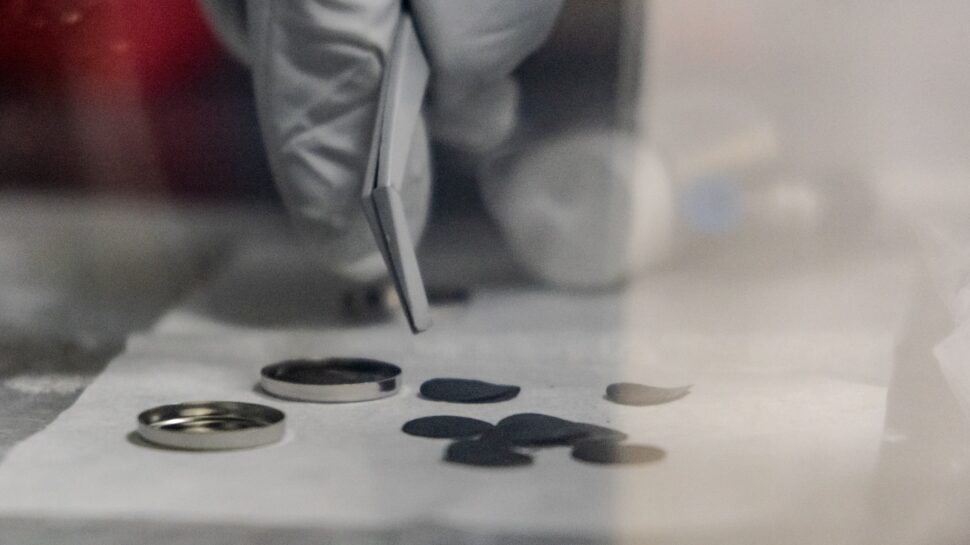

Using unique instruments and facilities, scientists are studying battery materials from the atomic level sizes up to 7 Ah pouch cells, large enough to make market decisions yet small enough to affordably demonstrate the impact of innovative technologies.
Researchers are exploring the use of advanced materials such as high-voltage ceramic oxides and Si nanoparticles to improve the energy density of lithium-ion batteries. High-resolution microscopy, microstructural and magnetic characterization, high-resolution chemical mapping, 3-D surface profiling, and mechanical pinch testing capabilities enable in-depth investigation of new battery materials.
Scientists also use advanced computational modeling to accelerate prototyping of cell designs, to screen new battery materials, to determine the effects of electrode coating defects on cell performance, and to develop accurate lifetime predictions.
Open to any US battery manufacturer, material supplier, equipment manufacturer, or battery end user, the center offers the ability to integrate any component into a complete battery and analyze how well it works and how it can be improved. Users can access individual processes and steps in a plug-and-play manner, and laboratory staff can provide help and guidance every step of the way. The idea is to showcase the user’s material or process improvements and quantify the advantage they provide.

Equipment and Capabilities
Colloid and dispersion design and characterization
Multiple high-shear mixers
Mixing and coating technologies and processes
Roll-to-roll calender for coating compaction
Advanced drying and solvent removal technologies
Roll-to-roll corona plasma treater for surface energy enhancement
Solventless processing
High-power-density photonic processing for solid-state batteries
Electrode architecture optimization
Automatic stacking machine with Z-folding configuration
Computational manufacturing
Ultrasonic joining and vacuum sealing
Thermal runaway characterization
375 channels ranging from 200 mA to 100 A for battery cycling
Three coating and fabrication lines (two slot-die and one tape casting) with reconfigurable deposition modules
Multiple environmental chambers for low and high temperature cell testing
65 m2 (700 ft2) dry space with 0.1% relative humidity
65 m2 (700 ft2) space with adjustable 0.1–15% relative humidity
Glove box space for wet chemistry and wetting characterization experiments

Contact
Ilias Belharouak
Corporate Fellow
Head of Electrification Section