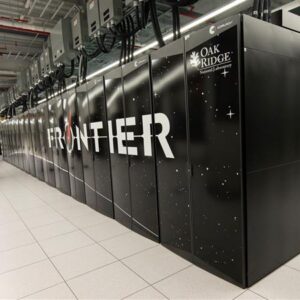
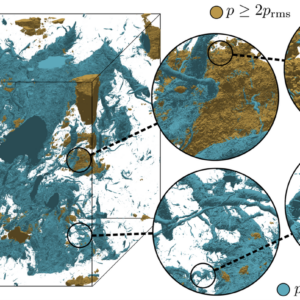
Researchers used the world’s fastest supercomputer for open science to train an artificial intelligence model that captures magnetic turbulence within a plasma in unprecedented detail. Results from the model could support research ranging from modeling a supernova to building the next generation of nuclear fusion reactors.
Adrian Sabau, a computational materials scientist at ORNL, has received the Materials Processing & Manufacturing Division (MPMD) Distinguished Service Award from The Minerals, Metals & Materials Society (TMS), recognizing his sustained contributions to the field and service to the professional community.
Researchers at ORNL will share their discoveries and innovations at DOE’s Advanced Research Projects Agency-Energy Energy Innovation Summit in San Diego, California.
ORNL researchers have developed Photon, a framework that accelerates the discovery of vulnerabilities in artificial intelligence models by scaling testing across the Frontier exascale supercomputer. The system uses coordinated, automated attack strategies to identify and refine weaknesses in AI models, helping improve their security and reliability in critical applications.
ORNL postdoctoral associate Jakob Bludau was named a 2026 Better Scientific Software Fellow, recognizing his leadership in advancing sustainable, high-performance scientific software and highlighting ORNL’s role in shaping the future of computational science.
ORNL is announcing the creation of the Institute for Next-Generation Data Centers, a new national institute dedicated to advancing the design, operation and integration of artificial intelligence data centers into the United States’ energy system.
Nina Gottschling is a Wigner Fellow at ORNL whose research focuses on uncertainty quantification, inverse problems, and photonic quantum computing, with an emphasis on mathematical accuracy bounds for AI and scientific computing. She bridges rigorous mathematics, simulation and experiment to advance computational and quantum technologies.
Experiments conducted between 2002 and 2012 at ORNL studied 31 tin isotopes with varying numbers of neutrons to examine how neutrons affect nuclear stability and nuclear properties. The combined results contributed to identifying tin-132 as a doubly magic nucleus and improved theoretical models of nuclear structure.
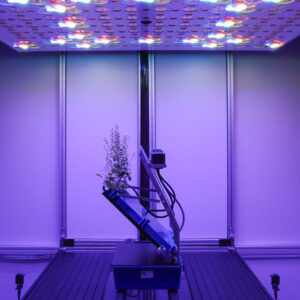
ORNL has launched a novel robotic platform to rapidly analyze plant root systems as they grow, yielding AI-ready data to accelerate the development of stress-tolerant crops for new fuels, chemicals and materials. The new platform adds belowground imaging to ORNL’s Advanced Plant Phenotyping Laboratory.
A research agreement between ORNL and Louisiana State University will accelerate energy generation and critical materials manufacturing and enhance job growth in the fuel and chemical industries, particularly in the Gulf Coast region.
Using the Frontier supercomputer at ORNL, researchers from the Georgia Institute of Technology have performed the largest direct numerical simulation of turbulence in three dimensions, attaining a record resolution of 35 trillion grid points.
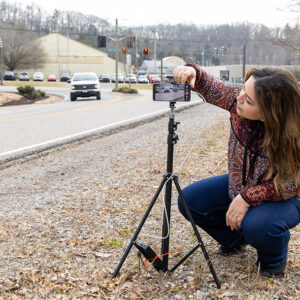
Researchers at ORNL have developed a deep learning algorithm that analyzes drone, camera and sensor data to reveal unusual vehicle patterns that may indicate illicit activity, including the movement of nuclear materials.