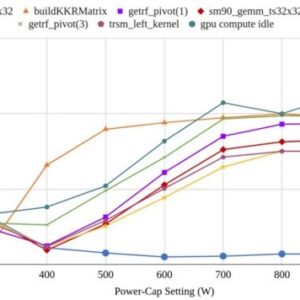
This research demonstrates that applying custom, task-specific power limits to modern superchips is a highly effective strategy for saving significant amounts of GPU energy in high-performance computing. By meticulously analyzing the relationship between power, performance, and GPU energy consumption, the study proves that a one-size-fits-all approach is inefficient.
Achievement As supercomputers become exponentially more powerful, their energy consumption has emerged as a major operational and environmental concern. This research contributes to the understanding of measuring and analyzing the energy used by powerful computing chips GPUs, when running two different large-scale scientific simulations. By providing a detailed, application-level view of power traces and energy
Scientists at ORNL have created a new method that more than doubles computer processing speeds while using 75 percent less memory to analyze plant imaging data. The advance removes a major computational bottleneck and accelerates AI-guided discoveries for the development of high-performing crops.
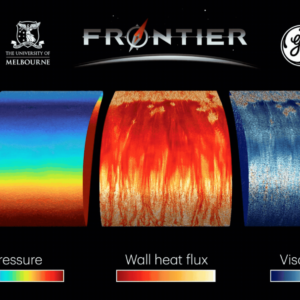
In a long-running collaboration with GE Aerospace, researchers at the University of Melbourne in Australia have been steadily working to improve the performance of high-pressure turbine engines
After more than 25 years of experience in condensed matter physics, as a student, researcher and in high-ranking executive roles at neutron scattering sources around the globe, Jon Taylor brings a wealth of experience and accomplishments to his new
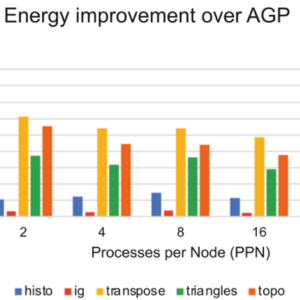
High-performance computing systems consume vast amounts of energy, particularly when moving data between different parts of the machine. To address this challenge, a research team investigated a novel strategy for optimizing data transfers.
Giri Prakash, lead for the Earth System Informatics and Data Discovery Section at ORNL, has been elevated to senior member of the Institute of Electrical and Electronics Engineers.
ORNL is beginning a four-year collaboration exploring the use of high-performance computing (HPC) to drive innovation around nonequilibrium quantum materials. This collaborative effort, Controlled Numerics for Emergent Transients in Nonequilibrium Quantum Matter will create an interdisciplinary research program to transform how scientists model and understand the complex behaviors and processes that happen when quantum materials are out of balance.
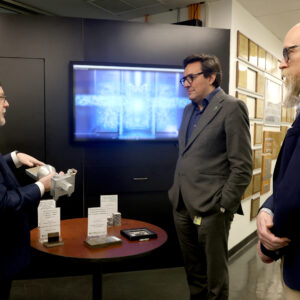
At SC25, DOE Undersecretary Dario Gil joined national labs in spotlighting the accelerating integration of AI, quantum and HPC, while ORNL delivered multiple talks and demonstrations on emerging computational technologies. ORNL teams also won Best Paper, Best Student Paper and several additional honors.
Building on ORNL’s legacy in health physics, Caleigh Samuels uses AI to modernize radiation dosimetry models. Her work provides federal agencies with the accurate data needed to strengthen nuclear safety.
Five breakthrough simulation projects conducted on the Frontier supercomputer at ORNL have been named finalists for the Association for Computing Machinery’s Gordon Bell Prize. Four of the projects are in the running for the main prize and one project is contending for a special prize.
The innovative Celeritas project, led by ORNL, provides a software tool that makes sure simulations used to analyze particles can run on the fastest supercomputers, accelerating answers about the nature of the universe.