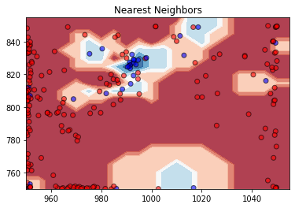
A multidisciplinary team of researchers from Oak Ridge National Laboratory (ORNL) and other institutions created a Machine Learning (ML) library for the training of classifiers on spectrographic chemical data.
This invention introduces a novel framework for detecting masquerade attacks in the CAN bus using graph machine learning (ML). We hypothesize that the integration of shallow graph embeddings with time series features derived from CAN frames enhances the detection of masquerade attacks. By representing CAN bus frames as message sequence graphs (MSGs) and enriching each
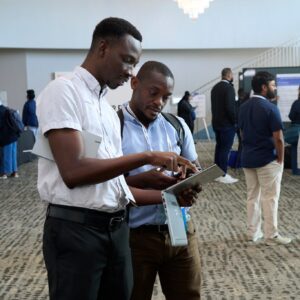
The National Center for Computational Sciences, located at the Department of Energy’s Oak Ridge National Laboratory, made a strong showing at computing conferences this fall. Staff from across the center participated in numerous workshops and invited speaking engagements.
FREDA is a new tool being developed at ORNL that will accelerate the design and testing of next-generation fusion devices. It is the first tool of its kind to combine plasma and engineering modeling capabilities and utilize high performance computing resources.
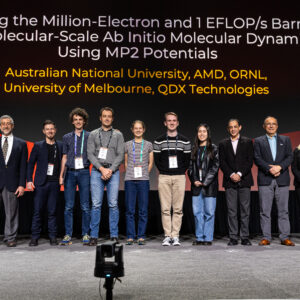
This year’s Association for Computing Machinery’s Gordon Bell Prize in supercomputing goes to researchers led by the University of Melbourne who used the Frontier supercomputer to conduct a quantum molecular dynamics simulation 1,000 times greater in size and speed than any previous simulation of its kind.
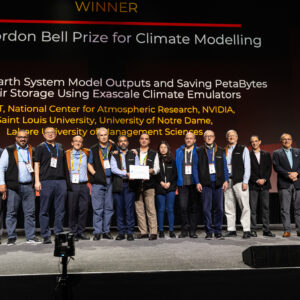
The 2024 Gordon Bell Prize for Climate Modelling has been awarded to a team of researchers led by the King Abdullah University of Science and Technology, or KAUST, Saudi Arabia, who used the Frontier supercomputer to develop an exascale
In early November, researchers at the Department of Energy’s Argonne National Laboratory used the fastest supercomputer on the planet to run the largest astrophysical simulation of the universe ever conducted. The achievement was made using the Frontier supercomputer at Oak Ridge National Laboratory.
ORNL has been recognized in the 21st edition of the HPCwire Readers’ and Editors’ Choice Awards, presented at the 2024 International Conference for High Performance Computing, Networking, Storage and Analysis in Atlanta, Georgia.
Two-and-a-half years after breaking the exascale barrier, the Frontier supercomputer at the Department of Energy’s Oak Ridge National Laboratory continues to set new standards for its computing speed and performance.
To bridge the gap between experimental facilities and supercomputers, experts from SLAC National Accelerator Laboratory are teaming up with other DOE national laboratories to build a new data streaming pipeline. The pipeline will allow researchers to send their data to the nation’s leading computing centers for analysis in real time even as their experiments are taking place.
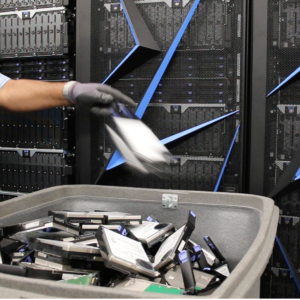
The Summit supercomputer, once the world’s most powerful, is set to be decommissioned by the end of 2024 to make way for the next-generation supercomputer. Over the summer, crews began dismantling Summit’s Alpine storage system, shredding over 40,000 hard drives with the help of ShredPro Secure, a local East Tennessee business. This partnership not only reduced costs and sped up the process but also established a more efficient and secure method for decommissioning large-scale computing systems in the future.
Nuclear physicists at the Department of Energy’s Oak Ridge National Laboratory recently used Frontier, the world’s most powerful supercomputer, to calculate the magnetic properties of calcium-48’s atomic nucleus.